

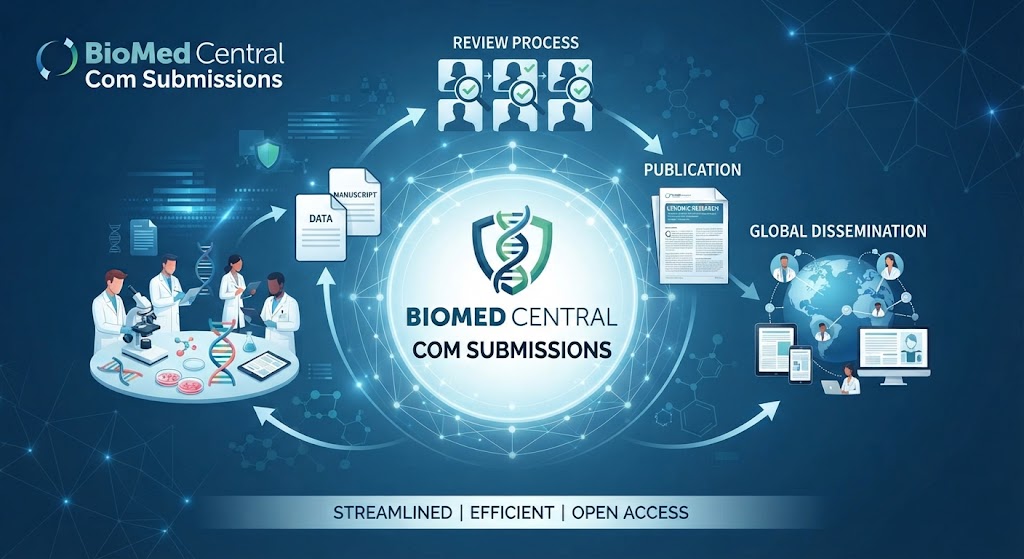
If you searched for biomedcentral com submissions, you are probably trying to find the correct place to submit a manuscript to a BMC journal. The main thing to know is that there is no single generic BMC submission page that every author should use. The safest route is to open the specific BMC journal on Springer Nature Link, read that journal’s submission guidelines, then use its Submit your manuscript button. Springer Nature gives the same journal-first guidance to BMC authors.
This matters because BMC’s web infrastructure has changed. Springer Nature states that, as of 25 November 2025, articles were removed from the older BMC platform and are now available on Springer Nature Link. At the same time, legacy BioMed Central pages and older institutional instructions remain discoverable in search, which can make the route to submission look inconsistent.
What Does “Biomedcentral Com Submissions” Mean Today?
The phrase biomedcentral com submissions is best understood as a navigational search rather than the name of one current submission portal. Older web pages and archived institutional instructions may still point to addresses such as biomedcentral.com/info/authors/submit or other legacy BioMed Central routes.
Those references can provide historical context, but they should not be your starting point for a new manuscript.
For a current submission, identify the journal first. Springer Nature advises BMC authors to locate their chosen journal, open its Submission Guidelines, and then follow its manuscript-submission link.
Quick answer
If biomedcentral com submissions brought you here because you need the current portal, follow this sequence:
- Find the exact BMC journal on Springer Nature Link.
- Read its aims and scope to confirm that your manuscript fits.
- Open Submission Guidelines and select your article type.
- Check manuscript formatting, declarations, figures, tables, data requirements, and fees.
- Click Submit your manuscript on the journal page.
- Sign in or register using the submission system presented by that journal.
Do not rely on an old saved URL when the current journal page provides a newer submission link. Think of biomedcentral com submissions as a search phrase that should lead you to the current journal-level route, not as one permanent universal address.
Why the Submission URL May Look Different From Older BMC Links
One reason biomedcentral com submissions can be confusing is that current and legacy systems overlap in search results.
Springer Nature’s general support documentation describes BMC manuscript submission through Editorial Manager. However, the current BMC Public Health page has a Submit your manuscript link pointing through a Springer Nature submission domain.
That does not necessarily mean one source is wrong. Submission systems may differ by journal or change as publishing infrastructure is updated. In practice, a biomedcentral com submissions search should end on the current page of the journal you have chosen, where you can follow its live Submit your manuscript link.
This distinction also helps prevent another common error: reaching a Springer Nature account page for alerts, saved research, or other personal services and assuming it is the journal’s manuscript portal.
How to Prepare Before Starting a BMC Submission
Searching biomedcentral com submissions often means an author is ready to upload a paper, but reaching the portal is only part of the process. A manuscript can still encounter technical delays if required information or files are missing.
Before starting, prepare:
- your manuscript in the journal’s accepted editable format;
- title, abstract, keywords, and complete author details;
- affiliations and corresponding-author information;
- figures, tables, and supplementary files in the required formats;
- funding details;
- competing-interest declarations;
- ethics approval and consent information where applicable;
- an availability-of-data-and-materials statement where required;
- author-contribution details;
- a cover letter if required;
- reviewer information if the particular journal requests it.
Requirements differ between journals and article types.
For example, current BMC Public Health instructions specify double-line spacing, line and page numbering, SI units, and no page breaks in the main text. Accepted editable main-manuscript formats listed there include DOC, DOCX, RTF, and TeX/LaTeX. Those details should be treated as BMC Public Health requirements rather than automatically applied to every BMC title.
Step-by-Step BMC Manuscript Submission Process
1. Choose the correct journal
Do not begin with a generic biomedcentral com submissions URL. Begin with the journal.
Read its aims and scope, review the article types it accepts, and check that your study genuinely belongs within its subject area. A manuscript sent to an unsuitable journal can be rejected before external peer review.
If you have not selected a journal, Springer Nature also provides a Journal Finder that can suggest relevant titles from information such as a manuscript title, abstract, or keywords.
2. Read the instructions for your article type
A research article, review, systematic review, study protocol, software article, commentary, or other submission type may have different structural and reporting requirements.
Open the instructions for your exact article type instead of assuming that one manuscript format applies to every paper published by the journal.
3. Review fees and funding
BMC titles operate within Springer Nature’s open-access publishing portfolio, but publication charges and funding arrangements are journal-specific.
Check Fees and funding on the journal you plan to submit to rather than copying an APC from another BMC title.
For example, the current BMC Public Health page states that an article processing charge applies when an article is accepted, with the applicable charge determined at acceptance. It also describes funding arrangements, discounts, waivers, and country-tiered pricing relevant to that journal.
An APC is therefore different from assuming that every author must pay a generic fee simply to open a submission.
4. Complete the online submission carefully
Use the submit button displayed on the current journal page.
Sign in or create the account required by the journal’s system, then complete the manuscript metadata, author information, declarations, and file uploads.
Before clicking the final submit button, compare the portal information against the manuscript title page. Check especially:
- author spelling;
- author order;
- institutional affiliations;
- corresponding-author details;
- manuscript title;
- funding information.
Simple metadata inconsistencies can generate avoidable administrative queries.
5. Save your confirmation and manuscript number
Once the manuscript has been submitted successfully, retain the confirmation email and manuscript reference number.
These details can help you identify the correct record later and are useful when communicating with the editorial office.
What Happens After You Submit?
Springer Nature describes the post-submission editorial process as beginning with an initial quality check. This stage may include checks relating to authorship, competing interests, ethics approval, and plagiarism.
If the manuscript passes the initial checks, an editor can be assigned. The editor considers the paper and, where appropriate, selects peer reviewers. Following review, the editor may request revisions, accept the manuscript, reject it, or consider an article transfer depending on the circumstances.
Therefore, if biomedcentral com submissions is your route to a manuscript you have already submitted, do not automatically return to an old BioMed Central homepage. Use the submission system associated with your journal or follow the link contained in your submission-confirmation or editorial correspondence.
Common Submission Mistakes to Avoid
Authors searching biomedcentral com submissions can become so focused on finding the login page that they overlook the journal-specific rules that determine whether their submission is technically complete.
Common mistakes include:
- submitting without checking the journal’s aims and scope;
- following instructions copied from another BMC journal;
- uploading only a PDF when editable source files are requested;
- omitting required declarations;
- failing to provide required data-availability information;
- entering authors differently from the manuscript title page;
- assuming every BMC journal has the same APC;
- overlooking funding, waiver, discount, or institutional-support information;
- using an old bookmarked BMC submission URL;
- mistaking a general Springer Nature login page for a manuscript submission portal.
A short check of the journal’s current instructions is more reliable than an old submission checklist found elsewhere on the web.
If you return to biomedcentral com submissions after receiving a revision request, follow the journal’s current system and the revision instructions in the editorial correspondence rather than beginning a completely new manuscript submission.
Final Checklist Before You Click Submit
Use this checklist before completing any biomedcentral com submissions workflow:
| Check | What to confirm |
|---|---|
| Journal fit | Your manuscript matches the journal’s aims and scope |
| Article type | You are following the correct article-type instructions |
| Manuscript | The file type and formatting meet current requirements |
| Authors | Names, order, affiliations, and contact details are correct |
| Declarations | Required ethics, consent, funding, competing-interest, data, and contribution statements are included |
| Figures and tables | Files follow the journal’s current technical guidance |
| Fees | You have reviewed current APC and funding information |
| Portal | You entered through the current journal page |
| Confirmation | You retained the manuscript number and confirmation message |
The Bottom Line
The safest response to a search for biomedcentral com submissions is not to hunt for one universal BioMed Central upload page. Find the current page for your chosen BMC journal, verify its article-specific instructions, and use the submission button displayed there.
That approach reduces the risk of following outdated URLs and ensures that you see the current manuscript, policy, fee, article-type, and submission requirements before uploading your work.
