

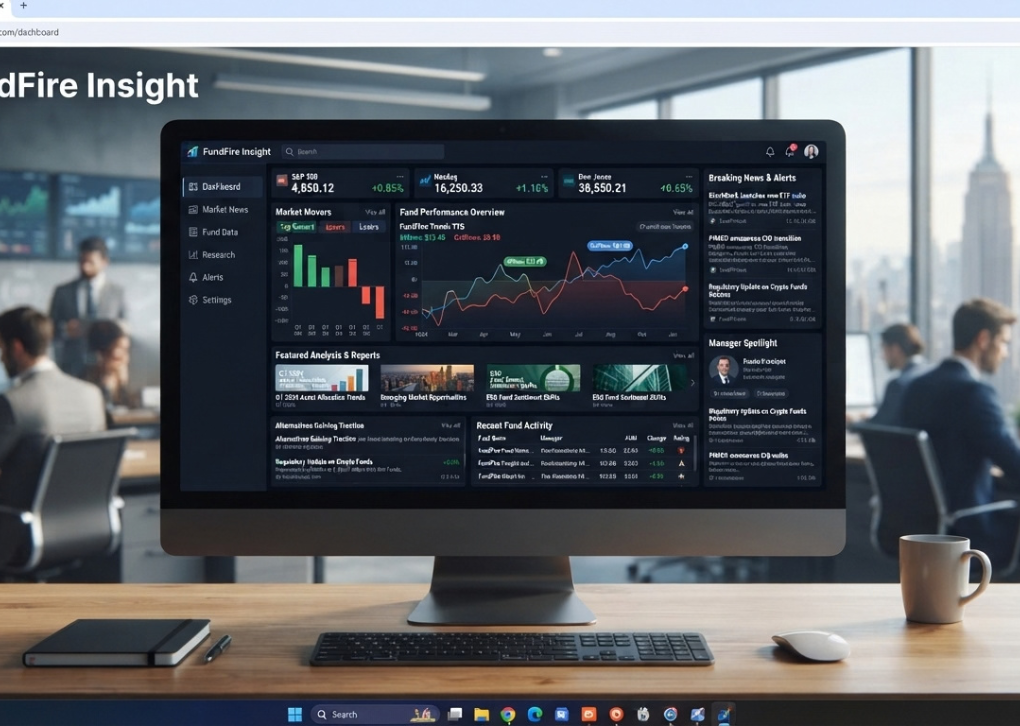
If you searched for Fundfireinsight.com, you may have encountered very different descriptions of the same domain. Some search results portray it as a sophisticated financial intelligence resource, while others describe a broader finance and business publishing website.
The difference matters.
A website can publish articles about investments, banking or stocks without being a brokerage, financial institution or professional investment-research provider. It can also have HTTPS without every financial claim on the site being accurate or independently verified.
Based on the current search landscape and available evidence, Fundfireinsight.com is best approached as a finance and business information website rather than an established institutional trading or portfolio-management platform. The available evidence also does not establish it as a bank, insurer, regulator or licensed investment firm.
There is another important issue: the name can be confused with FundFire, the established institutional asset-management publication. FundFire operates on a different domain and identifies itself as an industry news and competitive-intelligence service for investment professionals.
This review explains what can reasonably be established, what remains difficult to verify, and how readers should use financial information from a website of this type.
What Is Fundfireinsight.com?
Fundfireinsight.com appears to be an online publishing website covering finance and broader business subjects.
Current third-party descriptions associate the domain with topics including banking, credit cards, insurance, loans, investments and stocks. Other material associated with the domain extends beyond traditional finance into areas such as digital marketing, advertising, e-commerce and online services.
That broad subject mix is one of the most useful clues when assessing the site’s identity.
A specialist financial research company normally has a clearly defined product or research proposition. It might offer a fund database, portfolio analytics, institutional research, market-data terminals, manager research or authenticated client services.
A general publishing website has a different purpose: it explains topics through articles and guides.
The available evidence points more strongly toward the second model.
A limitation of this review
There is an important research limitation. An automated attempt to access the main domain during this review returned 403 Forbidden, which means the live homepage could not be independently inspected from the research environment.
Consequently, claims about individual live pages should be treated cautiously. Where direct verification was unavailable, this review relies on multiple current search results and available third-party evidence rather than presenting those descriptions as direct first-hand observations.
That distinction is particularly important for a financial topic.
What Kind of Content Is Associated With the Site?
The strongest recurring description across current search results is a multi-topic finance and business publishing model.
Reported subject areas include:
- Banking
- Credit cards
- Investments
- Stocks
- Loans
- Insurance
- General finance
- Business
- E-commerce
- Advertising
- Digital marketing
- Online services
This breadth can be useful for someone conducting preliminary research. A reader may be able to find an introductory explanation of a financial concept without navigating a specialist database.
At the same time, breadth should not be confused with specialization.
An article explaining a loan or investment concept is not automatically equivalent to research prepared by a regulated institution, investment manager, academic researcher or established financial newsroom.
That is why the individual article matters more than the domain name alone.
When reading a financial article, check its publication date, author, sources, methodology and whether important claims can be traced to primary evidence.
Is Fundfireinsight.com a Financial Institution?
There is no reliable evidence in the reviewed material establishing the domain as a bank, brokerage, insurance company, financial regulator or government organization.
This is one of the most important distinctions for readers.
A site can discuss:
- Investing without managing investments
- Insurance without selling insurance
- Loans without lending money
- Stocks without operating a brokerage
- Banking without being a bank
Publishing financial information and providing regulated financial services are separate activities.
The current SERP contains several descriptions that use terms such as “financial intelligence platform” or “investment insights platform.” Some of those descriptions go considerably further than what can be independently demonstrated.
The safer interpretation is to judge the domain by demonstrated functionality rather than by branding language.
If a website does not provide a verified brokerage account, institutional dashboard, documented research product or regulated financial service, readers should not assume that such functionality exists simply because the site discusses finance.
Why Does the Name Create Confusion With FundFire?
The name is probably one of the biggest reasons people search for the domain in the first place.
FundFire is an established publication serving professionals in the institutional asset-management industry. Its official site describes coverage for investors, managers, consultants, pension plans, endowments and foundations. It also identifies editorial staff and states that its editorial practices are governed by the Financial Times Editorial Code.
Fundfireinsight.com is a different domain.
That distinction is worth checking before assuming that information associated with one organization belongs to the other.
The similarity of terms can create an expectation of institutional research or professional asset-management intelligence. But a similar name is not evidence of corporate ownership, editorial affiliation, licensing or professional credentials.
For readers, the practical rule is simple: check the exact domain before relying on a financial source.
Is Fundfireinsight.com Legitimate?
The evidence reviewed does not establish the domain as a confirmed scam.
It also does not provide enough evidence to treat the website as a highly authoritative institutional financial-research provider.
Those two statements can both be true.
A website’s existence, HTTPS certificate or domain history can tell you something about its technical presence. They cannot prove that every article is accurate, that authors have relevant qualifications, or that the publisher provides professional financial advice.
Several current reviews reach a similar middle-ground conclusion: the domain appears to function as a real content website, but readers should distinguish its publishing activity from financial authority.
What legitimacy should mean here
For a financial website, legitimacy has several dimensions:
- Technical legitimacy — Does the site use normal secure web infrastructure?
- Identity transparency — Can readers determine who operates and publishes the site?
- Editorial credibility — Are authors, sources and editorial standards identifiable?
- Financial authority — Is the publisher actually licensed or regulated where such licensing would be required?
- Content reliability — Are important financial claims supported by current primary sources?
A positive answer to one question does not automatically answer the others.
Is Fundfireinsight.com Safe to Visit?
Available third-party reporting indicates that the domain uses HTTPS and Cloudflare-related infrastructure.
HTTPS is useful because it encrypts traffic between the browser and the website. But it is not a certification of editorial quality or financial credibility.
This distinction is easy to overlook.
A secure connection can protect the transmission of information while the information displayed on the page may still be outdated, incomplete or promotional.
Basic precautions are still worthwhile
If a page contains an investment, loan, insurance or financial-services offer, avoid providing sensitive information until the underlying company and offer have been independently verified.
Be especially careful with requests for:
- Banking credentials
- Card numbers
- Investment-account passwords
- Identity documents
- Tax information
- Large deposits
- Cryptocurrency transfers
- Remote-access software
If a financial offer is genuine, it should generally be possible to identify the underlying provider and verify the offer through that provider’s official channel.
Can You Trust Financial Information Published There?
The answer depends on the specific article, not simply the domain.
For basic educational reading, a general finance website can be useful. For a consequential financial decision, however, the verification standard should be much higher.
Google explicitly says its systems place greater emphasis on strong E-E-A-T signals for topics that can significantly affect people’s financial stability. Its guidance also recommends clear authorship, evidence of expertise and trustworthy sourcing.
That makes sense for financial content.
A practical verification process
Before acting on a claim, ask:
Who wrote it?
Look for an identifiable author and relevant background.
When was it published or updated?
Interest rates, regulations, tax rules and financial products can change.
What evidence supports it?
Prefer links to regulators, official company documents, government sources, filings and original research.
Is the article educational or promotional?
A commercial comparison can have a different purpose from independent research.
Does another authoritative source agree?
For important decisions, confirm the information independently.
This approach is more useful than trying to assign a single trust label to an entire website.
What About Guest Posts and Commercial Content?
Current search results also associate the domain with guest-content or publishing opportunities. One third-party marketplace currently lists the domain as a potential placement for banking and finance content.
That information is relevant to marketers and publishers, but it should be interpreted carefully.
A site accepting contributed or commercially placed content does not automatically mean that every article is unreliable. It does, however, make editorial context more important.
Readers should distinguish between:
- Independent editorial reporting
- Expert commentary
- Sponsored content
- Guest contributions
- Affiliate content
- Commercial comparisons
- Promotional material
For SEO professionals, the same principle applies. A site’s domain metrics or availability for guest placement do not by themselves establish editorial authority or guarantee long-term search value.
Google’s spam guidance specifically warns against creating large quantities of unoriginal content primarily to manipulate search rankings and emphasizes that content should provide genuine value to users.
What Are the Main Strengths and Limitations?
A balanced assessment is more useful than a blanket endorsement or dismissal.
| Area | What the evidence suggests |
|---|---|
| Topic coverage | Broad finance and business coverage |
| Accessibility | Content appears aimed at general readers |
| Financial specialization | Not clearly established as an institutional research provider |
| Regulatory status | No evidence reviewed establishes it as a regulated financial institution |
| Technical security | HTTPS and Cloudflare-related infrastructure have been reported |
| Editorial transparency | Publicly verifiable information appears limited |
| Domain history | Third-party records report registration in August 2023 |
| Commercial publishing | Guest-post activity is reported by third-party sources |
| Investment advice | Should not be assumed to be personalized professional advice |
The table highlights an important point: technical characteristics and financial credibility are separate issues.
A domain can have a functioning website and secure connection while still requiring careful scrutiny of its financial content.
What Should Investors Look for Instead of Relying on One Website?
The answer depends on what you are researching.
For a public company, look at its regulatory filings, investor-relations materials and audited financial information.
For an investment product, examine the provider’s official documentation, fees, risks, historical data and applicable regulatory information.
For a loan, verify the lender, interest rate, fees, eligibility rules and contractual terms directly with the lender.
For insurance, check the insurer, policy wording, exclusions, premiums and regulatory information.
For tax or regulatory questions, use the relevant government or regulatory authority.
For institutional investment research, established specialist publications and professional data providers may be more appropriate. FundFire, for example, explicitly positions itself around institutional asset management and provides identifiable editorial information.
The principle is straightforward: use a general article to understand a topic, then move to the strongest available primary source before making a consequential decision.
How Google’s People-First Principles Apply to Financial Content
This subject is also useful from an SEO perspective.
Google says helpful content should provide original value, demonstrate appropriate expertise, make authorship clear and avoid simply rewriting information from other websites. It specifically identifies financial stability as an area where stronger E-E-A-T matters.
For a finance website, that means a strong article should ideally provide:
- A clearly identified author
- Transparent publication and update dates
- Accurate citations
- Primary-source references
- Appropriate disclosures
- Clear distinction between fact and opinion
- Practical explanations rather than generic summaries
- Corrections when material information changes
Google also states that content created primarily to manipulate search rankings rather than help people can fall within its spam policies.
That is particularly relevant to the current SERP, where numerous pages about the same domain have appeared with remarkably similar descriptions.
What Does the Evidence Not Establish?
A careful review should also state what cannot be verified.
The available research does not establish:
- A regulated banking operation
- A brokerage service
- A proprietary trading terminal
- A verified investment-performance record
- A professional portfolio-management service
- A large verified user base
- A specific institutional research methodology
- That every published article receives professional financial review
Likewise, the evidence reviewed does not justify declaring the domain fraudulent simply because its public ownership or editorial credentials are not fully documented.
The appropriate conclusion is narrower: there is not enough independently verified evidence to treat the site as an established institutional financial authority.
That is a more useful conclusion than an unsupported “safe” or “scam” label.
How Readers Should Use Fundfireinsight.com
The most sensible approach is to treat the website as a starting point for information rather than the final authority on a financial decision.
For low-stakes educational research, an article may help explain unfamiliar terminology or introduce a topic.
For decisions involving substantial money, verify the relevant facts elsewhere.
A useful workflow is:
- Read the article to understand the topic.
- Identify its specific factual claims.
- Check the date.
- Find the original source behind important numbers or assertions.
- Verify the information with the relevant institution or regulator.
- Review the risks and costs independently.
- Seek qualified professional advice where the decision warrants it.
This approach remains useful regardless of whether the original article comes from a small finance blog, a major publication or a specialist research provider.
Fundfireinsight.com vs. FundFire: Why the Difference Matters
| Feature | Fundfireinsight.com | FundFire |
|---|---|---|
| Domain | fundfireinsight.com | fundfire.com |
| General positioning | Finance/business publishing | Institutional asset-management publication |
| Audience evidence | Broad/general readership | Investment managers, consultants and institutional professionals |
| Financial services | Not established as a regulated provider | Primarily a professional publication |
| Editorial transparency | Limited evidence available in this review | Official site identifies editorial staff |
| Financial Times relationship | No reliable evidence reviewed establishing one | Official site references FT Editorial Code |
FundFire’s official site describes its service as competitive intelligence for the separately managed account industry and identifies a professional editorial operation.
The two names should therefore not be treated as interchangeable.
Final Assessment
The current evidence supports a measured description of Fundfireinsight.com as a finance and business content website whose public identity and editorial authority are less clearly established than the name might suggest.
It should not be automatically treated as a bank, brokerage, regulated financial adviser or institutional investment terminal.
It also would be too strong to call it a confirmed scam based solely on the information reviewed here.
The more useful question is what a particular page is claiming, who produced it, what evidence supports the claim and whether the information can be confirmed through a primary source.
That approach protects readers from two opposite mistakes: dismissing a potentially useful educational article simply because it is from a general publisher, or giving a financial website more authority than its evidence warrants.
For any decision involving investments, loans, insurance, taxes or significant amounts of money, use the site as preliminary reading at most and verify the material through official documentation, regulators, providers or qualified professionals.
5. Frequently Asked Questions
What is Fundfireinsight.com?
Fundfireinsight.com appears to be a finance and business publishing website covering subjects such as banking, investments, loans, insurance, stocks and broader commercial topics. Available evidence does not establish it as a regulated financial institution.
Is Fundfireinsight.com legitimate?
The evidence reviewed does not establish the domain as a confirmed scam. At the same time, there is insufficient evidence to treat it as an established institutional financial-research provider. Readers should evaluate individual articles and verify important claims.
Is Fundfireinsight.com safe to visit?
Available third-party technical reporting indicates HTTPS and Cloudflare-related infrastructure. Those are technical security signals, not guarantees of financial accuracy. Avoid entering sensitive financial information into advertisements or unverified third-party services.
Is Fundfireinsight.com affiliated with FundFire?
The two websites use different domains. FundFire’s official website identifies itself as an institutional asset-management publication, while the evidence reviewed here describes Fundfireinsight.com as a broader publishing website. No reliable evidence reviewed establishes an affiliation between them.
Does Fundfireinsight.com provide investment or trading services?
There is no reliable evidence reviewed establishing the domain as a brokerage, trading terminal or regulated investment-management service. Its publicly described role is primarily informational and publishing-oriented.
Can I use Fundfireinsight.com for investment decisions?
It can be used for preliminary education, but important financial decisions should not depend on one article or website. Verify current figures, regulations, product terms and investment claims through primary sources and, when appropriate, qualified financial professionals.
When was the domain registered?
Third-party domain reporting cited by current reviews gives August 18, 2023 as the reported registration date. Domain age is background information, not evidence of financial expertise or trustworthiness.
