

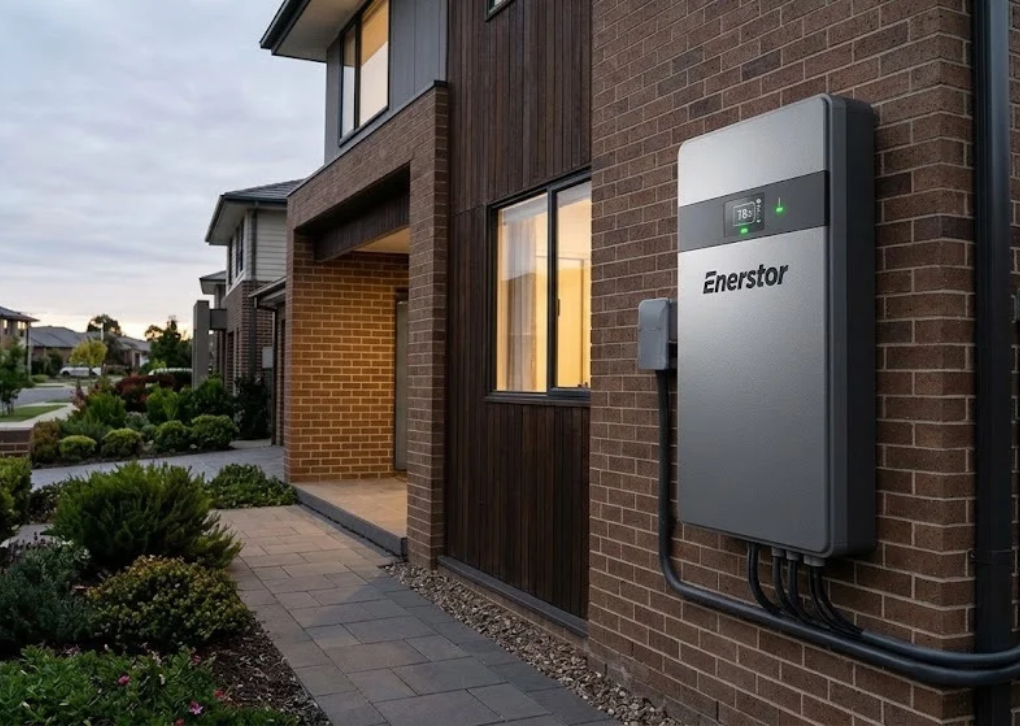
Enerstor appears in searches for battery storage, solar equipment, businesses and an earlier European engineering project. The difficulty is that these references do not describe one organization. A visitor looking for a modern battery supplier may encounter a research project from 2017, a Singapore company record or another brand with a similar name.
The clearest way to understand Enerstor is to identify the organization behind each reference before examining its technology or services. This article separates the documented entities, explains how relevant energy-storage systems work and highlights what buyers should verify before relying on commercial claims.
What Is Enerstor?
Enerstor is a name used in multiple energy-related contexts. One well-documented example is a European Union-funded industrial project that investigated an energy-storage module for machine tools. Other appearances include businesses advertising solar batteries and storage systems, a Singapore corporate record, a Romanian renewable-energy operation and Foxconn’s similarly named storage brand.
The shared naming does not establish common ownership, licensing or a business relationship.
| Name or reference | What the available evidence establishes | Key distinction |
|---|---|---|
| Enerstor — EU project | German-led Horizon 2020 feasibility project for industrial power-peak management | Project closed in 2017 |
| EnerStorAI | Website offering custom battery packs, LiFePO4 products and storage-system components | Supplier claims require project-specific verification |
| Enerstor Pte. Ltd. | Singapore company with registration number 202429229Z | Struck off in January 2026 |
| EnerStor Romania | Public business profile describing photovoltaic and storage activities in Romania | Separate Romanian business identity |
| Fox EnerStor | Energy-storage brand named in Foxconn’s 2025 corporate materials | Not the same as the older EU project |
Context matters: an invoice, product datasheet, historical research report and corporate registry listing may all use near-identical names while describing different things.
The Original European Enerstor Project
Why industrial machine tools needed storage
Industrial equipment does not always draw electricity at a steady rate. Some machines require a brief burst of high power when starting, accelerating or performing a demanding operation. Those short peaks can be significant even when average power consumption is much lower.
An energy-storage module located near the equipment could charge during lighter operating periods and discharge during a short, intense demand spike. That reduces the maximum power the external electrical supply must deliver at one moment.
The 2017 Enerstor concept was intended to address this problem with modular storage connected to machine tools. Its purpose was load levelling, rather than simply storing daytime solar electricity for use overnight.
Who developed it, and when?
The European Commission’s CORDIS project record names EBM Erich Buchele Maschinenbau GmbH, based in Germany, as the coordinator. The recorded project ran from February 1 to July 31, 2017, under grant agreement 762138.
The documented total project cost was €71,429, including an EU contribution of €50,000. The work was a feasibility-stage activity involving technological and market assessment, discussions with specialists and consideration of commercialization.
Those figures describe the historical project’s funding, not the price of an energy-storage product available to purchase today.
What was actually demonstrated?
This distinction matters. The European record explains the intended energy and grid benefits, but an ambition is not the same as independently verified operating performance. Its final report also notes that competing developments reduced its original technological advantage and led to changes in commercialization strategy.
The publicly cited record does not establish that the original Enerstor design is now a commercially available product, nor does it justify a specific percentage saving for a factory.
Peak reduction may lower certain demand-based charges. It does not automatically lower total electricity consumed, because charging and discharging themselves create losses. Actual savings depend on the tariff, machinery duty cycle, storage efficiency and installed cost.
EnerStorAI and Today’s Battery-Storage Products
EnerStorAI is a more direct match for readers searching for solar batteries, customized power packs or commercial energy-storage equipment.
Its website describes lithium battery packs for applications including RVs, marine equipment, golf carts and industrial vehicles. It also advertises LiFePO4 energy storage, inverters, solar components and systems intended for commercial or industrial projects. Project discussions may cover voltage, capacity, mounting space, controls, cooling and operating conditions.
This is useful information about the supplier’s stated scope, but it should not be mistaken for an independently audited product catalogue. Exact battery performance, compliance certifications, production capability, warranty arrangements and delivery conditions must be confirmed for the particular product and destination market.
For example, a battery pack suitable for a golf cart cannot automatically be substituted for a home backup battery just because both use lithium chemistry. Their current demands, protection systems, chargers, operating environments and installation rules may be very different.
What Happened to Enerstor Pte. Ltd. in Singapore?
The Singapore business is an especially important case of name confusion.
Enerstor Pte. Ltd. was incorporated on July 18, 2024, according to a Singapore corporate-data listing, with Unique Entity Number (UEN) 202429229Z. The same listing identifies holding-company activities as its primary business classification.
More decisively, an official Singapore Government Gazette notice issued under Section 344A of the Companies Act states that the company was struck off the Register of Companies effective January 26, 2026.
That is a verified registry event. It does not establish misconduct, insolvency, fraudulent activity or any specific cause of the strike-off. Nor does it demonstrate a corporate relationship with EnerStorAI, the German project, Romanian EnerStor or Fox EnerStor.
Anyone considering a contract or reviewing an old company profile should check the exact legal entity and its latest official registry status rather than assuming that the presence of a listing means it remains active.
What About EnerStor Romania and Fox EnerStor?
The Romanian name appears in a business profile describing photovoltaic panels, batteries, inverters, home automation and professional training. That profile places EnerStor in Bragadiru, Ilfov, and gives 2024 as the year it was founded. These details are publicly stated business-profile information, not independent confirmation of every claimed product capability.
Fox EnerStor has a different corporate context. Hon Hai Precision Industry’s November 2025 investor presentation identifies the launch of its Fox EnerStor energy-storage brand in China.
Neither reference should be automatically merged with the 2017 EU project or the Singapore company. Similar names are insufficient evidence of a common parent company.
How Does Energy Storage Work?
Although the organizations differ, many of the technologies associated with the name share a basic idea: electricity can be stored when available and used when needed.
There are two measurements buyers should not confuse:
-
Power, measured in kilowatts (kW), describes how quickly a system can supply or absorb electricity.
-
Energy, measured in kilowatt-hours (kWh), describes how much electricity it can store or deliver over time.
Consider a simplified example. Supplying a steady 5 kW load for two hours requires 10 kWh of delivered energy. In practice, the battery must be sized with allowances for usable capacity, inverter losses, aging and operating limits. A product labelled 10 kWh does not guarantee two hours of usable backup at 5 kW.
For a factory, peak power may be the main concern. For a household, evening energy use or outage duration may matter more. A good system design starts with the demand profile rather than a battery capacity selected from a brochure.
Where Could Enerstor-Related Technology Be Useful?
Residential solar and backup power
A correctly configured solar-plus-storage installation can save daytime generation for evening use. If the system includes suitable backup or islanding capability, it may also support selected circuits during an outage.
Not every grid-connected solar battery installation provides backup power. The inverter, switching equipment, protected loads and local electrical rules determine what happens when the grid fails.
Commercial and industrial facilities
Businesses may use storage to shift electricity demand from expensive periods, control brief peaks or keep certain loads running through interruptions. The appropriate system depends on the site’s measured load profile and electricity tariff.
This application is particularly relevant to the original industrial Enerstor idea, but it should not be interpreted as evidence that today’s commercial suppliers use that original engineering design.
Off-grid and specialized equipment
Remote buildings, mobile equipment, boats and industrial vehicles may need batteries designed around specific charging sources, temperatures, vibrations and peak currents. In these situations, mechanical fit and safe electrical integration are just as important as advertised capacity.
How to Evaluate an Enerstor Supplier or Storage Product
Before purchasing a system, begin with the full legal company name and check that it matches the quotation, invoice, contract and registration details. A similar brand name or website address is not enough.
Next, request a dated product datasheet that states nominal and usable capacity, voltage, maximum continuous and peak current, operating temperature, protections and communication interfaces. Ask how these specifications apply to your intended load.
A serious technical review should also address local installation standards, documented product testing, the relevant certification scope, compatible inverters, spare-parts support and warranty exclusions. A supplier’s broad statement that equipment is “certified” is less useful than a current document identifying the exact model and test standard.
Finally, compare lifetime costs rather than advertised battery size alone. Review installation cost, expected duty cycle, replacement assumptions, maintenance, round-trip efficiency, electricity tariffs and the consequences of downtime.
Lithium battery systems require appropriate design and professional installation. Thermal management, protection against electrical faults and installation conditions all affect safety. Buyers should not infer that a particular battery chemistry eliminates fire risk.
Is Enerstor a Good Choice?
There is no responsible single answer because the name does not identify one product, manufacturer or operating company.
The historical European project is useful for understanding industrial peak levelling, but it is not proof of a currently purchasable system. A modern supplier may offer equipment worth evaluating, yet its suitability can only be judged against verified specifications, documentation, support and the particular application. The Singapore corporate record requires a different assessment altogether because that legal entity was struck off in 2026.
The practical decision is to identify the exact organization, confirm its present status and compare the technical evidence against your needs.
Final Thoughts
Enerstor is best understood through its specific context, not as a blanket label for all battery technology. The EU project, a modern supplier’s catalogue, a Romanian business profile, Foxconn’s storage brand and Singapore’s historical company record are different references.
For technical research, begin with the European project documentation. For a purchase or partnership, verify the precise legal entity and request current model-specific evidence before committing money or designing a system around promised performance.
5. Frequently Asked Questions
1. What is Enerstor?
Enerstor is a name associated with several energy-storage projects and businesses. One documented example is an EU-funded industrial storage project from 2017. Similar names also appear in modern battery-supply businesses, a Singapore corporate record and other energy-storage brands.
2. Who developed the original Enerstor project?
The original European project was coordinated by EBM Erich Buchele Maschinenbau GmbH in Germany. It received €50,000 in EU funding under Horizon 2020 and investigated modular energy storage for industrial machine tools.
3. Is Enerstor Pte. Ltd. still active in Singapore?
No. Singapore’s Government Gazette records that Enerstor Pte. Ltd., registration number 202429229Z, was struck off the Register of Companies effective January 26, 2026. A fresh official registry search is appropriate before entering any transaction involving the name.
4. Is EnerStorAI the same company as Enerstor Pte. Ltd.?
No verified evidence establishes that they are the same legal entity. EnerStorAI operates a website advertising energy-storage products, while Enerstor Pte. Ltd. is a separately identifiable Singapore company that was struck off the register.
5. Is Enerstor connected to Foxconn?
The similarly named Fox EnerStor brand is connected to Foxconn, according to the company’s 2025 investor materials. That does not establish any relationship between Foxconn and the original European project, EnerStorAI or the Singapore entity.
6. Can Enerstor-related battery systems reduce electricity bills?
They can potentially reduce bills when properly designed around electricity tariffs, demand peaks and usage patterns. However, savings are not guaranteed. Installation cost, efficiency losses, battery degradation and operating schedules determine whether a particular system makes financial sense.
7. Can an Enerstor solar battery provide power during an outage?
A suitable solar battery system may provide backup electricity when paired with compatible inverters, switching equipment and properly configured backup circuits. Not every battery installation supports this function, so buyers should confirm the exact equipment specifications before purchasing.
