

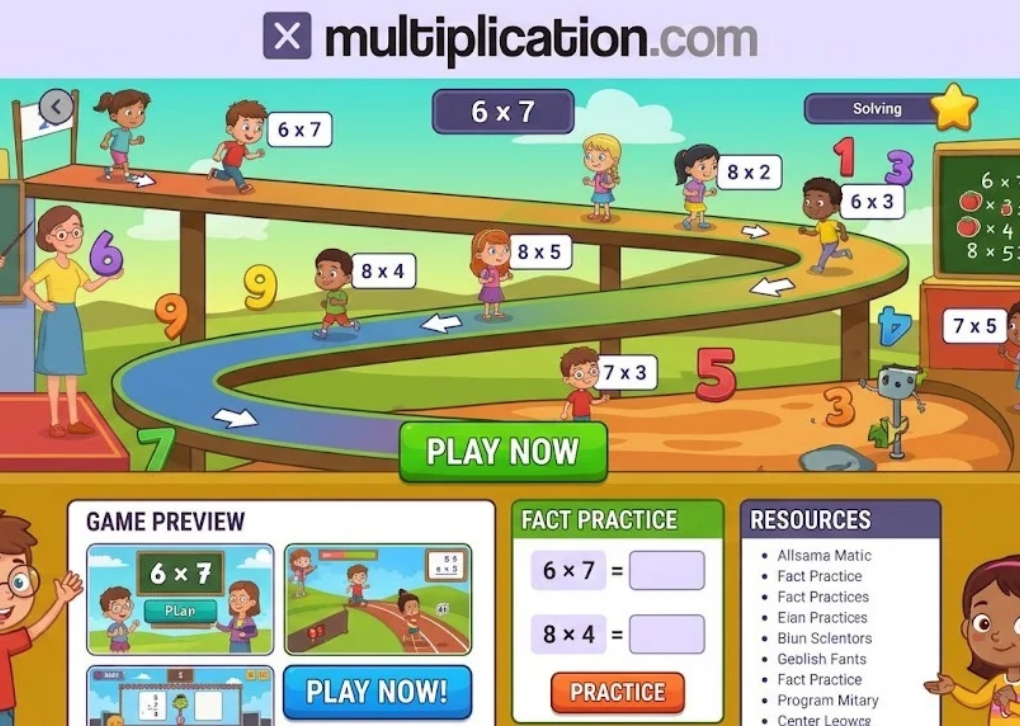
Learning multiplication becomes easier when children understand the numbers behind each answer and have regular opportunities to practice. Multiplication.com offers an online learning environment where students can work on multiplication facts through educational games, guided lessons, interactive quizzes, and printable activities.
The platform is designed to support children who are learning their times tables as well as those who need extra practice to improve accuracy and recall. Parents can use its resources at home, while teachers can incorporate suitable activities into classroom instruction.
This guide explains what the website offers, how to get started, which resources to explore first, and how to use online math practice effectively.
What Is Multiplication.com?
Multiplication.com is an educational website focused on helping children learn and practice basic multiplication facts. It provides digital activities intended to make mathematics more approachable through visual explanations, games, instructional materials, and assessments.
The official website also provides resources for addition, subtraction, and division, making it useful for broader arithmetic practice.
communitywww.multiplication.com+1
Rather than relying exclusively on memorization, its learning resources combine explanations and practice. A child who struggles with a particular multiplication fact can revisit a lesson, use a visual clue, or work through a related activity before attempting the question again.
The website is particularly relevant to elementary-school learners who are developing their understanding of multiplication and building confidence with times tables.
You can visit the official Multiplication.com website to explore the available learning activities.
Key Features of Multiplication.com
The website includes several types of resources, each serving a different purpose. Choosing the right one depends on whether a student needs an explanation, additional practice, or a way to check their progress.
1. Interactive multiplication games
Educational games are one of the platform’s central features. They give students opportunities to answer multiplication questions while participating in activities with visual and game-based elements.
The official teaching resources describe games intended to develop accuracy and fluency through practice. Examples listed on its games page include Pirates, Car Wash, Cone Crazy, and Sketch’s World. The availability of individual games may vary as the website changes.
com.multiplication.com+1
Games can be particularly helpful when conventional worksheets begin to feel repetitive. A student might be more willing to answer another set of multiplication questions when those questions are connected to a playful challenge.
However, the educational value comes from practicing the mathematics, not simply spending time playing. Parents and teachers should check that the chosen game actually reinforces the skill the child needs.
2. Step-by-step multiplication lessons
Some children can remember a multiplication answer but do not fully understand why it is correct. Others need help recognizing patterns before they can memorize the facts.
The learning section of Multiplication.com offers a structured approach that combines visual stories, review activities, explanations, games, and progress checks.
A student can use this approach to work through an unfamiliar fact before moving on to faster practice. For example, a child learning \(6 \times 4\) can first understand that the expression represents six groups of four, giving a total of 24.
This connection between multiplication and equal groups helps make the answer meaningful rather than something to memorize without context.
3. Interactive quizzes and assessments
Quizzes help students check whether they can recall multiplication facts without relying on hints or repeatedly reviewing the lesson.
The website describes self-scoring quizzes, automatic timing and scoring, visual hints, and progress-reporting features in its learning resources.
multiplication.com+1
These tools can help a learner identify which facts need more attention.
For example, a student might answer most questions correctly but repeatedly struggle with the seven and eight times tables. That information can guide the next practice session.
A useful assessment routine is to begin with untimed questions, correct misunderstandings, and then introduce timed practice when the child is comfortable with the material.
Speed should support accuracy, not replace it.
4. Printable multiplication worksheets
Digital activities are convenient, but written practice still has a place in mathematics learning.
Multiplication.com lists printable resources, including worksheets, flashcards, quizzes, coloring pages, and other educational materials. Some resources may have different access conditions, so check the individual item before assuming it is available without registration or payment.
multiplication.com+1
Worksheets allow students to work away from the screen and show their calculations on paper. They can also help teachers assess whether a child can solve multiplication problems independently.
A simple worksheet routine might include:
-
Five questions reviewing familiar facts.
-
Ten questions targeting a difficult multiplication table.
-
Five mixed questions testing recall across several tables.
-
A brief review of any incorrect answers.
The aim is to combine repetition with feedback rather than asking children to complete large amounts of identical work.
5. Flashcards and instructional videos
Flashcards are useful for short recall exercises. One side presents a multiplication problem, while the other provides the answer.
Instructional videos can introduce a fact, demonstrate a strategy, or reinforce a visual memory technique. These resources are useful when a student benefits from seeing and hearing an explanation before practicing independently.
For the best results, avoid showing a video and immediately moving to an unrelated activity. Follow the explanation with a few questions that require the child to use what they have just learned.
How to Use Multiplication.com Step by Step
A simple routine helps students get more value from the platform without feeling overwhelmed.
Visit Multiplication.com. Start with the learning section or browse the games and resources to find an activity suitable for the student’s current level.
Begin with a few questions or a short quiz. Notice which multiplication facts are easy and which require counting, hints, or repeated attempts.Step 3: Learn before memorizing
If a student does not understand a fact, revisit its lesson or use a visual model. For instance, \(4 \times 5\) can be represented as four groups of five objects.
Choose a game that reinforces the same facts covered in the lesson. Start at a comfortable difficulty and increase it as the student becomes more confident.
Step 5: Check progress and review mistakes
Finish with a short quiz or a few written questions. Review incorrect answers and return to difficult facts during a later session.
The exact navigation and available features can change. If a menu or game is different from the instructions above, use the current website’s learning and resource sections.
Is Multiplication.com Free to Use?
The website advertises online learning activities and games, and it provides access to various educational resources. However, not every resource should be assumed to be free or available under identical conditions.
Some activities may be available directly, while other materials or features can have different access requirements. The website’s current pricing, membership details, and individual resource pages should be checked before making a purchase or creating an account.
For families looking for supplementary math practice, a sensible starting point is to explore the public learning pages and determine whether the available activities meet the child’s needs.
Before paying for any additional access, consider:
-
Whether the desired games or lessons are included.
-
Whether printable resources are available to download.
-
Whether an account is required.
-
Whether the subscription or purchase terms are clearly stated.
-
Whether the resources suit the student’s grade and learning level.
This approach avoids paying for features that the child may not use.
How Multiplication.com Can Help Children Learn Times Tables
Multiplication facts are used throughout elementary mathematics. Greater familiarity with these facts can make later work involving division, fractions, measurement, and multi-step calculations easier to manage.
An online learning platform can support this development in several ways.
Building accuracy before speed
Children sometimes try to answer multiplication questions quickly before they understand the facts. This can lead to repeated errors and frustration.
Begin by helping the student calculate the correct answer. Use equal groups, arrays, repeated addition, or known facts to explain the result.
For example:
Once the child understands the relationship, repeated practice can help make the answer easier to recall.
Making difficult facts more manageable
Some multiplication facts are easier to remember than others. Students may quickly learn multiplying by zero, one, two, five, or ten but need more practice with other combinations.
Instead of revisiting every fact equally, concentrate on the ones that cause difficulty.
For instance, a child who knows \(5 \times 8 = 40\) can use that knowledge to solve \(6 \times 8\) by adding another eight:
This strategy develops number sense and gives the student another way to check an answer.
Encouraging regular practice
Short, consistent sessions are often more manageable than one long session filled with repetitive questions.
A parent might schedule ten minutes of multiplication practice after homework. A teacher could use a brief game as a warm-up before a mathematics lesson.
The key is to revisit previously learned facts instead of practicing only the newest material. Regular review gives students opportunities to strengthen recall over time.
Supporting different learning preferences
Some students respond well to pictures and stories. Others prefer written exercises, spoken explanations, or quick quizzes.
Multiplication.com provides multiple resource formats, allowing parents and teachers to choose activities that suit the immediate learning objective.
It is still useful to switch between formats. A child who answers questions correctly in a familiar game should also practice answering them on paper and in mixed question sets.
That helps show whether the knowledge transfers beyond the original activity.
Benefits and Limitations of Multiplication.com
Like any educational resource, the platform works best when its strengths and limitations are understood.
| Benefits | Limitations to consider |
|---|---|
| Games can make repeated practice more engaging. | Some children may focus on winning rather than understanding the mathematics. |
| Lessons can help explain unfamiliar multiplication facts. | A child may still need direct instruction from an adult. |
| Quizzes offer a way to check answers and recall. | Timed activities can create pressure for students who need more time. |
| Printable resources support offline practice. | Access to particular materials may vary. |
| Multiple formats support different teaching approaches. | Screen-based practice alone may not develop every necessary math skill. |
The most effective choice is not necessarily the game with the most excitement or the quiz with the fastest timer. It is the resource that helps a child understand a concept, practice it correctly, and use it independently later.
Tips for Parents Using Multiplication.com at Home
Parents do not need to become mathematics specialists to support their children’s multiplication practice. A clear routine, patient feedback, and a little observation can make a meaningful difference.
Set a small, achievable goal
Choose one specific objective for each session, such as learning the three times table or reviewing difficult facts from the six times table.
A focused target makes it easier to recognize progress and prevents practice from becoming an endless activity.
Ask children to explain their answers
When a child answers \(3 \times 8 = 24\), ask how they know the result.
They might describe three groups of eight, add eight three times, or use a known multiplication fact. Explaining the answer helps reveal whether the child understands the concept or has simply memorized a response.
Use mistakes as learning opportunities
If a child gives the wrong answer, avoid immediately moving to the next question. Ask them to work through the problem again or demonstrate it with objects.
For example, small blocks, buttons, or pencils can represent equal groups. Concrete examples are especially useful when abstract number sentences are confusing.
Balance screen time with offline activities
An online game can introduce practice, but multiplication can also be explored during everyday activities.
Ask a child to calculate the number of plates needed for four people, with each person receiving three biscuits. Discuss how repeated addition relates to multiplication.
These simple exercises help children recognize that multiplication is useful outside a website or classroom.
Celebrate progress without overemphasizing speed
Improvement may mean making fewer mistakes, understanding a difficult fact, or completing a short exercise without help.
Recognizing these achievements can encourage children who do not immediately perform well in timed games.
How Teachers Can Use Multiplication.com in the Classroom
Teachers can use the website as a supplementary resource before, during, or after a lesson.
As a lesson warm-up
A short multiplication game can help students recall familiar facts before moving on to a new concept. Choose an activity that matches the lesson rather than selecting a game solely because it is popular.
For targeted practice
Students often progress at different rates. While one group reviews basic multiplication facts, another may be ready for mixed practice or more challenging questions.
Separate activities and printable exercises can help teachers provide additional work without requiring every student to complete exactly the same task.
For assessment and review
Short quizzes can highlight areas where students need additional support. Teachers can use the results alongside classroom observations and written work to decide what to reteach.
A quiz score should not be the only measure of understanding. A student may know how to calculate a product but need more time to recall it, while another may answer quickly without being able to explain the reasoning.
For homework and independent practice
A teacher can recommend a particular learning activity for students who need reinforcement at home. Clear instructions about the targeted multiplication facts help parents support the task without guessing which resource to choose.
Teachers should also check current access requirements and any school policies regarding student accounts, privacy, and online services.
Is Multiplication.com Safe for Children?
The website is designed for children’s mathematics learning and publishes a privacy policy describing its information practices. However, parents should evaluate online safety based on the current policy and the features a child will actually use.
The official privacy policy explains that the service is operated by IXL Learning, Inc. and discusses information collection, use, sharing, children’s privacy, and parental rights.
multiplication.com
Before allowing a child to use the website independently, parents should:
-
Review the privacy policy and applicable terms.
-
Check whether an account is necessary for the intended activity.
-
Understand what information may be collected or retained.
-
Supervise younger children while they navigate online content.
-
Use appropriate browser, device, and family safety settings.
-
Avoid entering unnecessary personal information.
Privacy policies and website features can change, so reviewing the current terms is more useful than relying on an old review or a third-party description.
It is also worth distinguishing educational suitability from data privacy. A website can offer useful learning materials while still requiring parents to make informed decisions about accounts, information sharing, and supervision.
Common Mistakes to Avoid When Practicing Multiplication Online
Online practice can become less effective when the activity is poorly matched to the student’s needs.
Choosing games without a learning goal: A child may enjoy playing but make little progress on the multiplication facts they find difficult. Select activities that directly reinforce the intended skill.
Prioritizing speed over accuracy: Timed challenges can be useful later, but a student who repeatedly guesses needs more explanation and untimed practice first.
Practicing only familiar questions: Repeating easy facts can build confidence, but students also need opportunities to work on weaker areas and answer mixed questions.
Skipping error review: An incorrect answer is a chance to identify a misunderstanding. Reviewing it helps prevent the same mistake from becoming a habit.
Relying entirely on digital tools: Written calculations, verbal explanations, physical objects, and everyday examples provide complementary ways to learn.
Ignoring signs of frustration: If a child becomes upset or disengaged, reduce the difficulty, shorten the session, or return to an easier concept. Learning should be challenging without becoming discouraging.
Is Multiplication.com the Right Choice for Your Child?
Multiplication.com is worth exploring if your child needs additional practice with times tables and responds well to interactive activities.
It may be particularly useful when a learner needs a combination of explanations, games, quizzes, and printable materials rather than a single type of exercise.
Before settling on it as a regular resource, consider the child’s age, current mathematics level, preferred learning style, and need for adult guidance. Check whether the desired resources are accessible under the current website terms and whether they align with school expectations.
For children who are struggling with the underlying concept, start with explanations and visual models rather than immediately introducing timed games. For children who understand multiplication but need more fluent recall, short games and mixed quizzes can provide additional practice.
The best results come from using the website with a clear purpose and reviewing what the child learns away from the screen.
Final Thoughts
Multiplication.com offers a variety of educational resources for children learning multiplication facts, including games, lessons, quizzes, and printable materials. Its main advantage is the ability to combine different practice methods within one learning environment.
Parents and teachers can make the most of these resources by setting clear goals, helping students understand difficult facts, reviewing mistakes, and balancing online activities with written and practical exercises.
Visit the official website to explore its current offerings and select activities that fit your child’s learning needs.
5. Frequently Asked Questions
1. What is Multiplication.com used for?
Multiplication.com helps children learn and practice multiplication facts through interactive games, lessons, quizzes, flashcards, and printable educational resources. Parents and teachers can use these materials to supplement mathematics instruction.
2. Is Multiplication.com free?
The website offers online learning activities and educational resources, but access conditions may differ between features. Check the current website and individual resource pages to determine whether a particular activity requires payment or registration.
3. How do you practice multiplication on Multiplication.com?
Start by choosing a multiplication lesson or game that matches the student’s level. Practice the relevant facts, review incorrect answers, and finish with a short quiz or written exercise to check understanding.
4. Can teachers use Multiplication.com in classrooms?
Yes. Its teaching resources include instructional materials, games, quizzes, and printable activities that teachers can incorporate into classroom lessons, targeted practice, and homework assignments.
5. Does Multiplication.com offer printable worksheets?
Yes. The website lists printable educational resources, including worksheets, flashcards, and quizzes. Availability and access requirements may vary by resource.
6. Is Multiplication.com appropriate for young children?
Its educational activities are designed to help children learn mathematics. Parents should select age-appropriate activities, supervise younger users, and review the website’s privacy policy before allowing independent use.
7. Can online multiplication games replace traditional practice?
No single learning method is sufficient for every child. Online games can supplement instruction, but written exercises, visual models, verbal explanations, and regular review help children develop a broader understanding of multiplication.
