

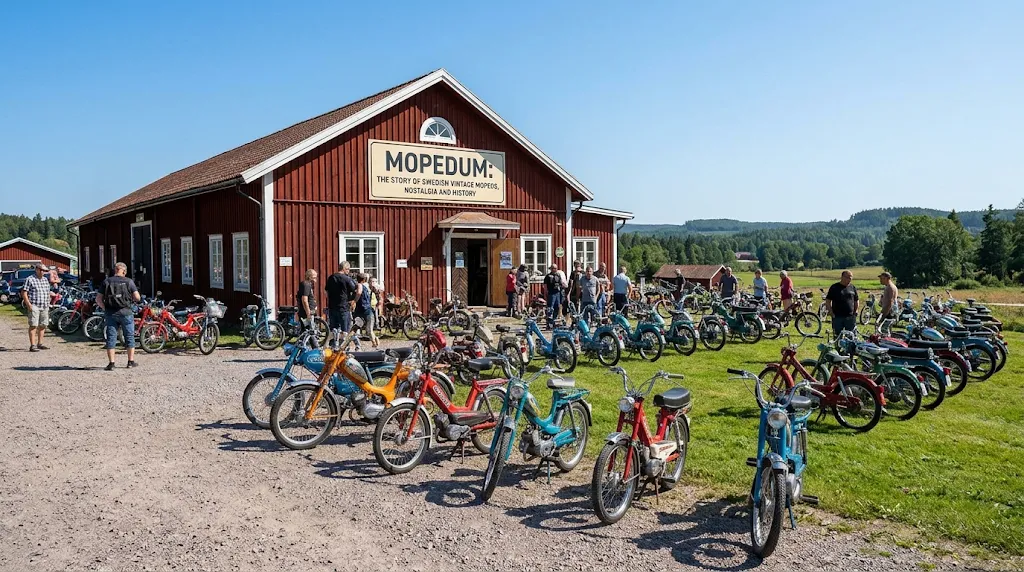
Mopedum is a name associated with Swedish vintage mopeds, classic scooters and the nostalgia of everyday life during the twentieth century. It is also the name of a former Swedish museum that brought together historic two-wheelers and ordinary objects from earlier decades.
Located in Nynäshamn, south of Stockholm, the original Mopedum Svenska Nostalgimuseet offered visitors an opportunity to explore Swedish life through vehicles, clothing, household objects and recreated historical environments. Its central historical period covered 1952 to 1979.
However, there is an important update for anyone researching the attraction: the original museum closed permanently in December 2022.
The name continues to appear online through Mopedum.se, a website focused on veteran mopeds, classic models, collections and related historical topics. Understanding the difference between the former physical museum and its current online presence makes it easier to explore the subject without confusing historical visitor information with present-day activities.
What Is Mopedum?
Mopedum refers to two connected but distinct things: the former Swedish nostalgia museum in Nynäshamn and the current website that publishes information about vintage mopeds.
The museum was known as Mopedum Svenska Nostalgimuseet. Its concept extended beyond displaying old motorcycles and mopeds. It recreated aspects of everyday Swedish life, allowing visitors to connect transportation history with the objects, styles and surroundings of previous generations.
Instead of presenting individual vehicles as isolated exhibits, the museum placed them within a wider cultural setting.
The online website, meanwhile, focuses on veteran mopeds, classic scooters, historical models and the appeal of older two-wheelers.
This distinction matters because an active website does not mean the former museum has reopened.
The History of Mopedum in Nynäshamn
The former museum was situated at Vikingavägen 39 in Nynäshamn, Sweden.
Its creators, Nisse and Lotta Skogmyr, developed a nostalgia experience around vehicles and everyday objects from earlier decades. Public historical reporting places the museum’s beginnings around 2012, when it started welcoming visitors interested in Swedish moped culture and retro history.
The collection covered a particularly interesting period: the decades when mopeds became a familiar part of transportation and popular culture in Sweden.
Visitors could encounter:
-
Vintage Swedish and European mopeds.
-
Clothing and fashion from earlier decades.
-
Traditional household objects.
-
Recreated historical interiors.
-
Toys, signs and nostalgic everyday items.
-
Objects representing shops and domestic environments.
The combination created a broader experience than a conventional vehicle exhibition.
A classic moped could illustrate technological development, while a nearby household object or recreated shop could help explain the environment in which that machine was originally used.
Why Nynäshamn Was Part of the Story
Nynäshamn provided the original setting for this independent nostalgia museum.
The town is located south of Stockholm and is associated with coastal communities, transport connections and access to the Stockholm archipelago.
For visitors interested in Swedish cultural history, the museum offered a different kind of attraction from conventional art galleries or large technology museums.
Its focus on familiar objects made the experience accessible to people who might not have had specialist knowledge of motorcycles.
The Golden Age of Swedish Mopeds: 1952–1979
One of the most interesting aspects of the Mopedum story is its connection with the development of Swedish moped culture.
The period from 1952 to 1979 represents an important chapter in the country’s transportation history.
According to historical research published through the Royal Institute of Technology in Stockholm, 1 July 1952 marked a significant regulatory change. The moped, then described as a bicycle with an auxiliary engine, was excluded from several restrictions that applied to heavier motorized two-wheelers.
This helped establish a distinctive place for mopeds in Swedish everyday transportation.
1950s: A New Kind of Personal Mobility
During the 1950s, mopeds represented an accessible way to travel without owning a conventional motorcycle or car.
Their relatively simple mechanical construction made them attractive to people looking for practical transportation.
They also introduced a new level of independence for younger riders and people living outside major urban centres.
1960s: Design and Everyday Culture
The 1960s brought continued development in moped design and consumer culture.
Different manufacturers introduced models with distinctive frames, styling, engines and practical features.
Mopeds increasingly became associated with personal identity as well as transportation.
For many owners, choosing a particular model was about appearance and preference, not simply getting from one place to another.
1970s: From Practical Transport to Recreation
By the 1970s, mopeds were firmly established as recognizable machines in Swedish popular culture.
Their appeal extended into leisure activities, mechanical hobbies and personal collecting.
The vehicles also became increasingly connected with memories of adolescence, independence and everyday social life.
This wider cultural significance helps explain why a nostalgia museum would preserve more than the machines themselves.
Which Vintage Moped Brands Were Associated With the Collection?
The surviving exhibition at Vällingby Centrum identifies several Swedish and European manufacturers represented in its moped display.
These include:
| Manufacturer | Historical relevance |
|---|---|
| Crescent | Recognized Swedish bicycle and moped manufacturer |
| Husqvarna | Swedish manufacturer with a long motorcycle history |
| Monark | Established Swedish bicycle and moped brand |
| Fram | Swedish name associated with bicycle and moped production |
| Victoria | German manufacturer with a history in motorcycles and mopeds |
Each manufacturer represents a different part of the wider European two-wheel industry.
For enthusiasts, these names are useful starting points when researching vintage models, original components, manufacturing periods and restoration requirements.
However, a manufacturer’s name alone is not enough to identify a specific vehicle. Model numbers, frame markings, engine details and original documentation are important when establishing a particular moped’s identity.
What Made the Mopedum Museum Different?
The museum’s appeal came from the relationship between vehicles and everyday life.
A conventional motorcycle museum might organize its exhibits primarily around engineering, brands or mechanical development.
Mopedum took a broader approach.
It used mopeds as an entry point into Swedish social history.
More Than a Collection of Vehicles
A vintage moped can reveal details about manufacturing, transportation and design.
But surrounding objects can provide additional context.
For example, a reconstructed 1950s kitchen can help visitors understand domestic life during the same period in which particular moped models were being used.
A historical shop environment can illustrate how consumer goods were presented and sold.
Clothing and toys can reveal changing styles, interests and everyday experiences.
These details create connections between transportation history and ordinary human experiences.
Nostalgia Across Generations
Nostalgia is not limited to people who personally experienced a particular decade.
Older visitors may recognize objects from their childhood or early adulthood, while younger visitors can discover how technology, fashion and household environments have changed.
That generational connection is one of the reasons collections of everyday historical objects remain valuable.
They preserve details that might otherwise disappear from public memory.
Is Mopedum Museum Still Open?
No. The original Mopedum museum in Nynäshamn closed permanently in December 2022.
The closure followed the retirement of its creators, Nisse and Lotta Skogmyr.
The news is particularly important for travelers because older travel directories, reviews and historical attraction pages may still display the former museum’s address and descriptions.
Those listings should not be interpreted as current admission or opening information.
| Historical detail | Information |
|---|---|
| Museum | Mopedum Svenska Nostalgimuseet |
| Former location | Vikingavägen 39, Nynäshamn, Sweden |
| Creators | Nisse and Lotta Skogmyr |
| Historical focus | 1952–1979 |
| Closure | December 2022 |
| Current visitor status | Permanently closed |
There is no verified basis for treating the former Nynäshamn attraction as a currently operating museum.
What Happened to the Mopedum Collection?
The collection did not simply disappear when the original museum closed.
According to Vällingby Centrum’s official information, the shopping centre acquired the contents of the nostalgia collection and a number of the museum’s mopeds when its creators decided to retire.
The purpose was to preserve the historical material rather than allow the collection to be divided and auctioned off.
Parts of the collection subsequently became part of a new exhibition called Nostalgimuseum.
The exhibition features recreated environments and historical objects from 1952 to 1979.
Where Can You See the Former Collection Today?
Vällingby Centrum in Stockholm is the documented location where parts of the former collection can still be explored.
Its Nostalgimuseum includes recreated historical environments such as:
-
A traditional shop representing earlier retail experiences.
-
A 1950s Swedish domestic kitchen.
-
A recreated 1960s hair salon.
-
A children’s room inspired by 1970s design.
-
A selection of Swedish and European mopeds.
The moped display includes models associated with manufacturers such as Crescent, Husqvarna, Monark, Fram and Victoria.
One important distinction: this is a separate exhibition preserving parts of the former collection, not the original Mopedum museum reopening at a new address.
Visitors should check the exhibition’s current information before making a special trip.
What Is Mopedum.se Today?
The online presence of Mopedum is another important part of understanding the keyword.
The current Mopedum.se homepage presents itself as a website about veteran mopeds and nostalgia.
Its published topics include classic moped models, collections, moped history and considerations for people interested in buying older vehicles.
The available homepage content includes articles covering subjects such as:
-
Things to consider before buying a veteran moped.
-
Popular vintage moped models.
-
The history of Monark.
-
The development of Swedish mopeds.
-
The origins of the moped.
These subjects make the website relevant to people who want to explore older two-wheelers beyond the history of the former museum.
What Can Readers Learn From the Website?
The most useful way to approach a vintage-moped website is to treat it as a starting point for research rather than assume every published description is sufficient for a purchase or restoration decision.
Readers interested in collecting can explore historical models and manufacturers.
Potential buyers can investigate what to examine before purchasing an older vehicle.
Restoration enthusiasts can use historical material to identify components, design characteristics and relevant terminology.
However, specific technical details should always be checked against manufacturer documentation, original vehicle records or qualified restoration expertise.
Is the Current Website the Same as the Former Museum?
The name is shared, but the two should not automatically be treated as the same operating organization.
The former museum was a physical attraction in Nynäshamn. The current website publishes online content about vintage mopeds and nostalgia.
Available public information establishes these two uses of the name, but does not independently establish that the current website has the same ownership or organizational continuity as the former museum.
This distinction prevents confusion when researching the brand.
Why Vintage Mopeds Still Attract Collectors
Vintage mopeds appeal to different types of enthusiasts.
Some people are interested in their mechanical simplicity. Others appreciate the design, manufacturing history or memories associated with particular models.
There are also collectors who enjoy restoring older machines and preserving them in working or historically accurate condition.
Mechanical Simplicity
Many older mopeds used relatively straightforward mechanical systems.
Depending on the model, their construction can make certain maintenance and repair tasks more accessible than those involving modern electronically controlled vehicles.
That does not mean every vintage moped is easy to restore. Older components may be worn, modified or difficult to source.
Distinctive Historical Design
Older mopeds often have visual characteristics that make them recognizable.
Frame geometry, fuel-tank shapes, seat designs, wheel sizes and engine placement can differ considerably between manufacturers and production periods.
These details are part of their historical appeal.
Restoration and Preservation
Restoring a vintage moped involves more than making it look attractive.
A careful restoration considers the original specifications, mechanical condition, component compatibility and historical authenticity.
For anyone purchasing an older model, checking the frame number, engine identification and available documentation is a sensible first step.
How to Research or Buy a Vintage Moped
For readers who discover Mopedum through an interest in collecting, the following considerations can help avoid common mistakes.
1. Identify the exact model.
Do not rely exclusively on appearance. Check manufacturer markings, frame identification and engine information.
2. Examine the mechanical condition.
Look for corrosion, damaged components, engine wear, leaking seals and signs of previous repairs.
3. Check documentation.
Original documents, registration history where applicable and historical specifications can help establish a vehicle’s identity.
4. Investigate spare-part availability.
Some vintage components are easier to find than others. Research this before purchasing a restoration project.
5. Verify applicable regulations.
Vehicle classifications, registration and riding requirements depend on the country and the vehicle’s technical specifications.
For Sweden, the Transport Agency distinguishes between Class I and Class II mopeds. Current definitions generally distinguish them by design speed: up to 45 km/h for Class I and up to 25 km/h for Class II, subject to additional technical requirements.
Older Swedish mopeds can have different historical classifications, so checking the individual vehicle’s documentation is important.
The Lasting Significance of Mopedum
Mopedum represents more than an interest in old vehicles.
Its former museum demonstrated how transportation, design, household objects and popular culture can be brought together to tell a wider historical story.
Although the original attraction in Nynäshamn closed in 2022, parts of its collection have continued through the Nostalgimuseum at Vällingby Centrum.
Meanwhile, Mopedum.se provides a separate online destination for people interested in veteran mopeds and their history.
Understanding these distinctions gives readers a clearer picture of what the name represents today: a connection to Sweden’s vintage moped culture, a former nostalgia museum and an ongoing online subject for enthusiasts and historical researchers.
5. Frequently Asked Questions
1. What is Mopedum?
Mopedum is associated with Swedish vintage moped culture and nostalgia. It was also the name of a physical museum in Nynäshamn that displayed classic mopeds alongside historical clothing, household objects and recreated environments.
2. Is the original Mopedum museum still open?
No. The original museum permanently closed in December 2022 after its creators, Nisse and Lotta Skogmyr, retired. Its former location should not be treated as an active visitor attraction.
3. Where was Mopedum located in Sweden?
The former museum was located at Vikingavägen 39, 149 40 Nynäshamn, Sweden, south of Stockholm.
4. What happened to the Mopedum collection?
Vällingby Centrum acquired the contents of the nostalgia collection and several of its mopeds. Parts of the collection are now displayed through its Nostalgimuseum exhibition in Stockholm.
5. Can you still see vintage mopeds from Mopedum?
Yes. Vällingby Centrum’s Nostalgimuseum displays a selection of Swedish and European mopeds from 1952 to 1979. The exhibition includes models associated with Crescent, Husqvarna, Monark, Fram and Victoria.
6. What can you find on Mopedum.se?
The website publishes information about veteran mopeds, classic scooters, historical manufacturers, vintage collections and Swedish moped history. It also includes material relevant to people researching or considering purchasing older mopeds.
7. Why is the period from 1952 to 1979 important to Swedish moped history?
It represents an important period in Swedish moped development, beginning with a significant regulatory change in 1952. During these decades, mopeds became increasingly associated with affordable transportation, personal independence, mechanical development and youth culture.
