

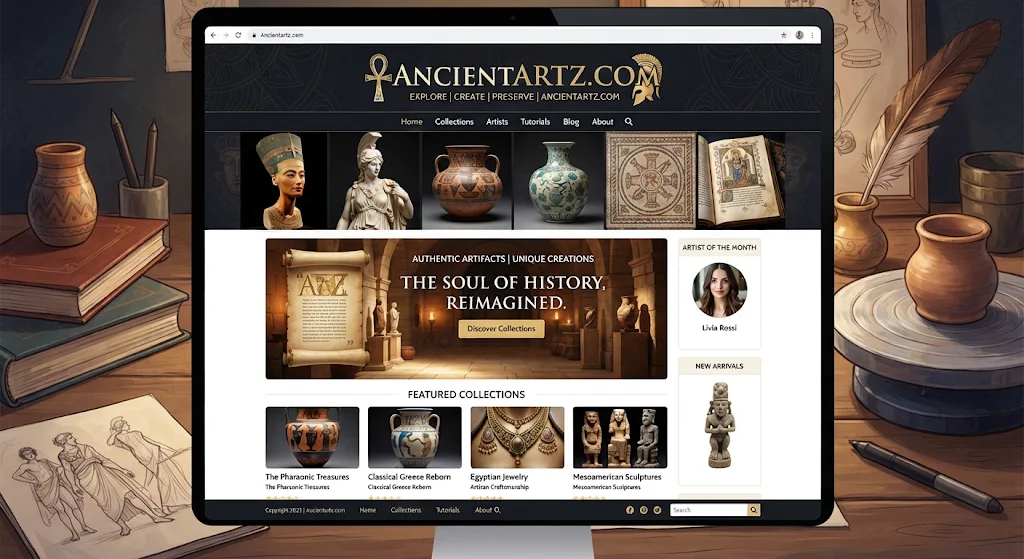
Searching for Ancientartz com may lead you to websites featuring ancient artwork, archaeological reproductions, historical collections, and cultural heritage. However, identifying the correct website requires some care because similarly named websites operate in different areas of the ancient-art world.
One relevant website is Ancient Arts, which focuses on experimental archaeology, handcrafted historical replicas, educational collections, and archaeological activities. Other similarly named websites specialize in antique objects and original works of art.
This distinction matters, particularly if you are looking for historical information, educational resources, or authentic ancient objects to purchase. Understanding what each website actually offers can help you find relevant collections and make better-informed decisions.
What Is Ancientartz com?
Ancientartz com is the search phrase used to locate a website or resource associated with ancient art. However, the available search evidence does not establish an independently verified business operating under the exact name Ancientartz.com.
One closely related resource is Ancient Arts, accessible through ancient-arts.org. Its website describes a business specializing in experimental archaeology, historical reconstructions, handmade artefact replicas, and educational activities.
The organization presents historical objects as practical ways to explore how people lived, worked, and created tools in earlier civilizations.
Its activities are particularly relevant to:
-
Archaeology enthusiasts.
-
Museums and heritage organizations.
-
Teachers and educational institutions.
-
Historical researchers.
-
Living-history groups.
-
People interested in traditional craftsmanship.
It is worth distinguishing this organization from similarly named antique dealers. A shared name does not establish shared ownership, management, or business operations.
What Can You Discover Through Ancient Art Websites?
Ancient art websites cover several areas of historical and artistic interest. Their collections may include original antiquities, modern reproductions, historical illustrations, educational materials, and information about ancient civilizations.
Understanding these categories makes it easier to find the resources that match your interests.
Ancient artefacts and archaeological objects
Ancient artefacts are physical objects created or used by people in earlier historical periods.
Examples include:
-
Egyptian pottery and amulets.
-
Roman coins and household objects.
-
Greek ceramics and sculptures.
-
Bronze Age tools and weapons.
-
Ancient glassware.
-
Decorative metalwork.
-
Historical jewellery.
These objects provide evidence about technology, trade, artistic traditions, religious practices, and everyday life.
When browsing an online collection, check whether an item is an original archaeological object, a modern reproduction, or a decorative piece inspired by historical designs.
Archaeological replicas and reproductions
Some organizations specialize in reproducing historical objects using traditional techniques and materials.
Ancient Arts is particularly relevant to this category. Its website describes handcrafted reproductions developed through archaeological research and experimental work.
Examples of historical reproductions include:
-
Prehistoric pottery.
-
Flint tools.
-
Bronze implements.
-
Iron Age weapons.
-
Bone needles and fishing equipment.
-
Reconstructed historical household objects.
These reproductions allow people to examine the shape, weight, construction, and potential function of objects that might otherwise remain inaccessible behind museum display cases.
Ancient paintings and sculptures
Ancient paintings and sculptures provide another important way to explore historical cultures.
Different civilizations developed distinctive artistic traditions, materials, and techniques.
For example:
-
Egyptian art frequently incorporated religious symbolism and representations of rulers.
-
Greek sculpture explored human anatomy, proportion, and idealized forms.
-
Roman sculpture included portraits, decorative reliefs, and public monuments.
-
Ancient Near Eastern art featured elaborate carvings, ceremonial objects, and architectural decoration.
Studying these traditions helps visitors understand how artistic expression reflected the beliefs, political structures, and social practices of earlier societies.
Understanding Ancient Arts and Its Archaeological Work
Among the websites related to the Ancientartz com search, ancient-arts.org provides useful information about archaeological reconstruction and educational resources.
The organization describes its work as combining practical craftsmanship with archaeological research.
Experimental archaeology
Experimental archaeology involves recreating historical technologies or activities to investigate how objects may have been produced and used.
For example, researchers might reconstruct a prehistoric tool and examine how its materials, shape, and construction affect its performance.
This approach can help researchers develop practical insights that complement archaeological evidence.
However, experimental results do not automatically prove exactly how every historical object was manufactured or used. They provide evidence that must be considered alongside archaeological discoveries and other research.
Historical craftsmanship
Traditional craftsmanship is central to making convincing archaeological reproductions.
Different historical objects require different materials and techniques.
| Historical object | Common materials | Reproduction techniques |
|---|---|---|
| Prehistoric pottery | Clay and natural temper | Hand building and firing |
| Flint tools | Flint and other stone | Controlled stone flaking |
| Bronze implements | Copper and tin alloys | Casting and finishing |
| Wooden tools | Appropriate timber | Carving and shaping |
| Bone needles | Animal bone | Cutting, shaping and polishing |
| Leather objects | Animal hide | Cutting, shaping and stitching |
The objective is not simply to create something that looks old. A well-researched reconstruction should communicate something meaningful about historical materials, manufacturing methods, or practical use.
Educational collections
Historical reproductions are especially useful in educational environments.
Students can examine objects closely, compare their construction, and discuss how people in the past used available natural resources.
For museums, schools, and heritage organizations, handling collections can provide a more engaging learning experience than photographs alone.
The Council for British Archaeology has also discussed the educational value of handling original and replica archaeological objects, emphasizing that replicas provide useful practical experiences while remaining distinct from historical originals.
Original Ancient Artefacts vs. Modern Replicas
One of the most important distinctions for anyone exploring Ancientartz com and related websites is the difference between an original historical object and a modern reproduction.
Although both may look similar, they have different historical and educational significance.
| Feature | Original artefact | Modern replica |
|---|---|---|
| Creation period | Historical period | Modern period |
| Historical connection | Direct connection to the past | Based on historical research |
| Material | Original historical material | Original or substitute materials |
| Main purpose | Research, preservation and collecting | Education, demonstration and display |
| Historical value | Evidence from the period | Evidence of modern reconstruction |
| Handling | Often restricted | Usually more suitable for handling |
A replica should not be considered inferior simply because it is modern.
In educational settings, reproductions offer practical advantages. They can allow students and visitors to handle objects without exposing valuable originals to unnecessary damage.
The important requirement is transparent identification. A reproduction should not be misrepresented as an authentic archaeological discovery.
How to Evaluate an Ancient Art Website Before Using It
If you discover a website through the Ancientartz com search, do not assume that its name alone establishes its reliability.
Whether you are researching historical information or considering a purchase, examine the website carefully.
1. Check the website’s identity
Look for information explaining:
-
Who operates the website.
-
Whether it identifies a registered organization or business.
-
Where the business is located.
-
How visitors can contact the operator.
-
Whether its ownership and business details are consistent.
A professional-looking website does not automatically establish the identity or credibility of its operator.
2. Examine product descriptions
A useful listing should provide meaningful information about the object.
For an antique or historical artefact, look for:
-
Object dimensions.
-
Materials.
-
Estimated historical period.
-
Cultural or geographical attribution.
-
Condition.
-
Restoration details.
-
Provenance information.
-
Whether the object is original or reproduced.
Avoid relying on vague descriptions such as “extremely rare” or “thousands of years old” without supporting information.
3. Investigate provenance
Provenance refers to an object’s documented history of ownership and, where possible, its earlier location and movement.
It is particularly important when evaluating ancient archaeological objects.
Useful documentation may include:
-
Previous ownership records.
-
Historical auction catalogues.
-
Exhibition records.
-
Old photographs.
-
Export documentation.
-
Published research.
-
Relevant collection inventories.
The Responsible Art Market’s antiquities due-diligence guidance recommends examining available ownership and exhibition records and investigating gaps in an object’s history.
A missing document does not automatically prove that an object is illegal. However, unexplained provenance gaps deserve careful investigation.
4. Review payment and purchasing conditions
Before making an online purchase, understand the seller’s conditions.
Check:
-
Accepted payment methods.
-
Delivery arrangements.
-
Return and refund policies.
-
Insurance provisions.
-
Import and export requirements.
-
Authenticity guarantees, where applicable.
For expensive historical objects, independent specialist advice may be worthwhile.
5. Distinguish educational suppliers from antique dealers
This is particularly relevant when researching Ancientartz com.
An organization producing archaeological replicas has a different purpose from a gallery selling original antiques.
An educational supplier may focus on historical reconstruction, teaching resources, and demonstrations. An antique dealer may concentrate on acquiring, documenting, appraising, and selling collectible objects.
Understanding this difference prevents confusion about what a website actually provides.
Why Archaeological Replicas Matter for Understanding History
Archaeological reproductions offer more than decorative representations of ancient objects.
They provide opportunities to investigate historical technology, craftsmanship, and everyday activities.
Making history tangible
A photograph can show the appearance of an ancient tool, but a reproduction can help a learner understand its dimensions, weight, balance, and construction.
This can make historical explanations easier to understand.
Supporting classroom education
Teachers can use reproductions to introduce topics such as:
-
Prehistoric technology.
-
Early metalworking.
-
Ancient food preparation.
-
Historical clothing and accessories.
-
Traditional pottery production.
-
Everyday life in ancient societies.
Students can compare different objects and discuss how technological developments changed human communities.
Helping museums communicate history
Museums sometimes use replicas alongside original collections.
Reproductions can help visitors understand how objects functioned without requiring valuable or fragile originals to be handled.
They can also illustrate missing components, historical manufacturing processes, or reconstructed appearances.
Preserving traditional skills
Recreating historical objects requires practical knowledge of materials and production methods.
Craft-based reconstruction can help document techniques that are difficult to understand through written descriptions alone.
It also creates opportunities to connect archaeological research with contemporary craftsmanship.
Popular Historical Periods and Their Artistic Traditions
Anyone exploring ancient art can benefit from understanding the historical periods represented in different collections.
Ancient Egypt
Egyptian art is recognized for its distinctive visual conventions, monumental architecture, religious imagery, sculpture, jewellery, and funerary objects.
Common collection categories include:
-
Amulets.
-
Figurines.
-
Ceramics.
-
Relief carvings.
-
Decorative objects.
-
Funerary equipment.
Ancient Greece
Greek artistic traditions include pottery, sculpture, architecture, and decorative metalwork.
Collections often feature painted vessels, mythological representations, marble sculptures, and objects connected with everyday activities.
Ancient Rome
Roman art reflects the development of sculpture, engineering, architecture, decorative design, and practical manufacturing.
Coins, pottery, glassware, metal objects, and architectural fragments are particularly useful for understanding Roman society.
Prehistoric and Bronze Age cultures
Prehistoric collections help illustrate the development of early technologies and human craftsmanship.
Stone tools, pottery, bronze implements, and reconstructed household objects provide insights into how communities adapted materials to meet practical needs.
These categories also demonstrate why archaeological replicas and original antiquities should be treated as separate but complementary resources.
Is Ancient Art Worth Exploring Online?
Yes. Online collections can be valuable starting points for historical research, education, and collecting.
However, the quality of information varies between websites.
A useful ancient-art resource should offer more than attractive photographs. It should provide accurate descriptions, meaningful historical context, transparent identification, and enough supporting information to help visitors understand what they are viewing.
For educational purposes, archaeological reconstruction websites can be especially useful.
For collectors, detailed object descriptions, reliable provenance, transparent purchasing conditions, and independent expert advice are more important.
When researching Ancientartz com, the most sensible approach is to verify the exact website first and then evaluate its actual content and services rather than assuming that similarly named organizations are connected.
5. Frequently Asked Questions
1. What is Ancientartz com?
Ancientartz com is a search phrase associated with ancient art and historical collections. However, current search evidence does not establish a verified operating website under the exact domain name Ancientartz.com. One related resource is Ancient Arts, which specializes in archaeological replicas and educational collections.
2. Is Ancientartz.com an official ancient-art website?
Its official ownership and business identity could not be verified during this research. The similarly named ancient-arts.org website provides information about an archaeological reproduction business, but that does not establish a connection with Ancientartz.com.
3. What can visitors expect from ancient art websites?
Depending on the website, visitors may find historical artefacts, ancient sculptures, paintings, archaeological reproductions, educational resources, and information about historical civilizations. Some websites also provide antique sales and collectible art listings.
4. Are archaeological replicas genuine ancient artefacts?
No. Archaeological replicas are modern reproductions based on historical evidence. They can accurately represent historical designs and manufacturing techniques, but they were not originally created during the ancient period they represent.
5. How can someone identify an authentic ancient artefact?
Authenticity requires careful examination of the object’s materials, construction, historical characteristics, condition, and provenance. Buyers should also consider independent specialist assessments and relevant ownership or export documentation.
6. Why are replicas important in museums and education?
Replicas allow students and museum visitors to examine historical objects through practical interaction. They help explain manufacturing techniques, object functions, materials, and everyday activities while reducing the need to handle fragile originals.
7. What should buyers check before purchasing ancient art online?
Buyers should investigate the seller’s identity, object description, provenance, authenticity documentation, condition, payment arrangements, and applicable import or export requirements. Expensive or culturally significant objects may require independent professional advice.
