

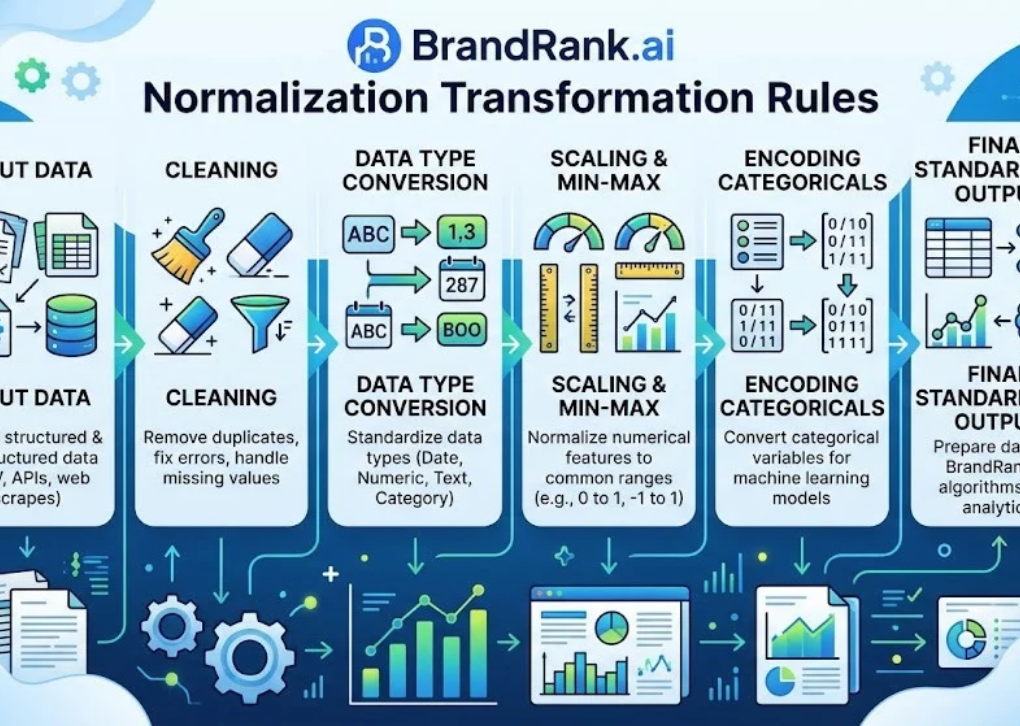
BrandRank.ai Normalization Transformation Rules is a search phrase associated with the way brand information can be cleaned, standardized and organized for AI-search visibility analysis. The underlying concepts are useful: a company may appear under several names, websites may be recorded in different formats, and AI-generated answers may describe the same brand in inconsistent ways.
Without careful data processing, these variations can distort reporting.
There is, however, an important distinction. BrandRank.AI publicly describes capabilities for analyzing brand visibility, recommendations and related signals across AI search experiences. An official technical specification under the exact name “Normalization Transformation Rules” has not been established from the publicly available documentation reviewed.
That means the sensible approach is to understand normalization and transformation as established data-management practices, not as a confirmed description of the platform’s private algorithms.
This article explains how those practices work, where they help, what can go wrong and how teams can apply them when evaluating brand visibility.
What Are BrandRank.ai Normalization Transformation Rules?
The phrase generally refers to two related data-processing activities: normalization and transformation.
Normalization makes information consistent. It can standardize capitalization, map verified name variations to a single company, remove duplicate records and establish common formats for dates or URLs.
Transformation converts information into a representation suitable for reporting, analysis or another system. It may turn an unstructured response into fields such as brand mentioned, recommendation status, source, sentiment and topic.
For example, a hypothetical company called Northstar Coffee might appear in different datasets as:
-
Northstar Coffee
-
NORTHSTAR COFFEE
-
Northstar Coffee Ltd.
-
northstarcoffee.example
A properly designed system could associate these references with one canonical company record, provided their identity is verified.
It could then transform the associated information into a structured report showing where the company appeared, which sources were cited and whether a particular answer recommended its products.
The purpose is to make comparisons more reliable without losing important context.
What Does BrandRank.AI Actually Document?
BrandRank.AI’s public-facing descriptions focus on how brands appear in AI-generated answers and how those appearances can be analyzed.
Public discussions of the platform describe concepts including AI search visibility, brand vulnerability, content readiness, competitive comparisons and Recommendation Share.
These are distinct from a publicly disclosed rulebook specifying the exact transformations applied to every incoming record.
An external article might reasonably propose useful normalization rules for working with BrandRank.AI-style data. It cannot establish the company’s internal implementation simply by attaching the platform’s name to those rules.
This distinction matters when evaluating technical documentation. A statement about what a platform measures is not necessarily a statement about how its software calculates that measurement.
Why Normalization Matters for AI Brand Visibility
AI-generated answers do not always mention organizations using the same wording.
A brand might be referenced through its full legal name, familiar trading name, website, product line or abbreviation. Some answers may describe a company without naming it directly.
If these references are handled inconsistently, reporting can become misleading.
Consider a hypothetical analysis of 100 responses about specialty coffee suppliers. A company appears in 18 responses under its primary name and in five additional responses under a verified abbreviation.
A system that recognizes only the primary name might report 18 responses containing the company. A system that correctly resolves both identities would identify 23.
That difference is meaningful, but it also reveals a potential problem: normalization must avoid counting the same response twice.
If the full name and abbreviation occur together in one response, they may represent two textual mentions but only one response containing the brand.
A reliable analysis therefore needs to distinguish between mention frequency, unique responses and actual recommendations.
These are different measurements, and combining them carelessly can produce incorrect conclusions.
The Core Normalization Rules Used in Brand Data Processing
The following rules are general data-engineering practices. They are not presented as a confirmed proprietary BrandRank.AI specification.
1. Standardize text formatting
Text normalization addresses differences that do not change meaning, such as unnecessary spaces or inconsistent capitalization.
For example:
" NORTHSTAR COFFEE " becomes "Northstar Coffee".
A processing pipeline might trim surrounding spaces, collapse repeated whitespace and apply consistent case handling.
The original value should still be retained. Keeping the raw record allows analysts to investigate errors and reconstruct the source material.
2. Resolve verified brand aliases
Alias resolution associates alternative names with the correct organization.
A company might operate under a registered corporate name while customers know it by a shorter trading name.
An alias dictionary can record these relationships:
| Input | Canonical entity | Treatment |
|---|---|---|
| Northstar Coffee | Northstar Coffee | Exact match |
| NORTHSTAR COFFEE | Northstar Coffee | Case-normalized match |
| Northstar Coffee Ltd. | Northstar Coffee | Verified legal-name alias |
| Northstar | Unresolved | Requires contextual review |
The last example is particularly important.
A short word may refer to multiple businesses, products or unrelated subjects. Automatically assigning every occurrence to one brand can create false positives.
A trustworthy system should support uncertain or unresolved matches rather than forcing every record into a category.
3. Normalize URLs without destroying identity
Web addresses may contain tracking parameters, different capitalization in hostnames or alternative representations of the same destination.
For instance:
https://www.example.com/products?utm_source=newsletter
and
https://www.example.com/products
may refer to the same underlying page for a particular analytical purpose.
Removing recognized tracking parameters can make source analysis more consistent.
However, URL normalization must be conservative. Query parameters sometimes change actual page content, and different URL paths may represent distinct resources.
It is also useful to distinguish a source domain from a specific cited page. Two articles hosted on one website are not automatically duplicate sources.
4. Detect duplicate records
Duplicate data can inflate brand visibility figures.
Imagine that an answer is collected twice because a request is retried after a connection interruption. If both copies enter the reporting dataset, the system may overstate the number of observations.
A deduplication process might compare a response identifier, collection timestamp, prompt identifier, model configuration and content fingerprint.
The appropriate rule depends on the analytical question.
Two identical answers generated independently may be legitimate observations of response consistency. An accidental duplicate ingestion of one response is not.
Deduplication should remove processing errors without erasing genuine repeated observations.
5. Standardize dates and timestamps
Brand monitoring often compares results across reporting periods.
If one source uses a local timestamp and another uses UTC, the same event may appear on different calendar dates.
A useful approach is to store timestamps in a consistent format, retain timezone information and define the reporting timezone explicitly.
This prevents avoidable errors in daily trends, weekly comparisons and scheduled reporting.
6. Preserve brand, product and company relationships
A parent organization may own several brands, while an individual brand may offer many products.
Those relationships should not be flattened into one entity.
For example, a recommendation for a specific product does not necessarily mean the answer recommended every product sold by its parent company.
A structured entity model can maintain separate identifiers for organizations, brands, products and product categories.
This is especially useful when comparing competitors with different corporate structures.
7. Handle missing information explicitly
A missing value is not the same as a negative result.
If a system cannot determine whether an answer recommended a brand, it should not automatically label the answer as “not recommended.”
A better classification might use three states: yes, no and undetermined.
Similarly, unavailable sentiment data should not be converted into neutral sentiment without justification.
Preserving uncertainty helps prevent false precision.
How Data Transformation Works
Once records have been normalized, they can be transformed into a consistent analytical structure.
Suppose an AI-generated response says:
“Northstar Coffee is one option for specialty beans, although delivery availability depends on location.”
A hypothetical transformation might produce:
| Field | Example output |
|---|---|
| Brand ID | brand_001 |
| Brand name | Northstar Coffee |
| Mentioned | Yes |
| Explicitly recommended | Undetermined |
| Topic | Specialty coffee |
| Delivery claim | Location-dependent |
| Sentiment | Mixed or neutral, pending rubric |
| Source response ID | response_1042 |
| Verification status | Not independently checked |
This structure separates what the response actually says from what an analyst concludes.
The answer names the company, but the phrase “one option” may not qualify as an explicit recommendation under every measurement framework.
A transformation system should apply a documented classification rubric instead of silently treating every mention as an endorsement.
Normalization vs. Transformation: Key Differences
| Aspect | Normalization | Transformation |
|---|---|---|
| Main purpose | Make data consistent | Make data usable for a particular analysis |
| Typical input | Inconsistent names or records | Raw or normalized information |
| Typical output | Standardized records | Structured fields, features or reports |
| Example | Match verified brand aliases | Classify whether an answer recommends a brand |
| Main risk | Incorrectly merging distinct entities | Introducing misleading classifications |
| Quality check | Identity and consistency validation | Schema and interpretation validation |
The two processes often operate together.
A transformation pipeline might normalize incoming text, resolve entities, classify observations and generate reporting records in a single workflow.
Even when these stages are automated, each should remain independently testable.
A Practical Workflow for Applying the Rules
Organizations do not need access to a proprietary ranking formula to improve the consistency of their own brand-monitoring datasets.
A practical workflow begins with clearly defined questions and finishes with validated reporting.
Step 1: Define what you want to measure
Decide whether the analysis concerns brand mentions, recommendations, source citations, factual accuracy or competitor comparisons.
These metrics should not be treated as interchangeable.
A brand may be frequently mentioned without being recommended. A positive description may not contain a purchase recommendation. A cited webpage may belong to a publisher rather than the brand being discussed.
Clear definitions prevent confusion later.
Step 2: Create a canonical brand registry
Assign each brand a stable identifier.
Record its verified trading names, relevant websites, associated products and relationships with parent companies.
Avoid treating a shared keyword or similar domain name as sufficient proof of identity.
For ambiguous aliases, require additional context or manual review.
Step 3: Collect the original observations
Store the full response alongside relevant metadata.
Useful fields include the prompt, collection time, platform or model, configuration when available, source references and response identifier.
Retaining the original observation is essential because classification rules may change.
Without the source text, it becomes difficult to investigate disputed matches or reproduce an earlier result.
Step 4: Apply normalization rules
Standardize formatting, resolve known aliases and normalize relevant URLs.
Flag uncertain matches rather than guessing.
Maintain a record of which rule changed each field. This makes the processing pipeline easier to audit.
Step 5: Transform the records
Extract structured observations such as brand presence, recommendation status, topic and cited sources.
Use consistent definitions for each field.
If a classification depends on judgment, document the criteria and allow an undetermined result when the evidence is insufficient.
Step 6: Validate the output
Review a sample of records against their original source material.
Check whether the system has incorrectly merged separate brands, missed known aliases or classified mentions as recommendations.
Where practical, compare classifications made by independent reviewers and resolve disagreements through a documented rubric.
Step 7: Calculate and report metrics
Only calculate aggregate metrics after validating the underlying records.
For example, a simple brand-presence rate can be expressed as:
This formula is illustrative. It is not claimed to be BrandRank.AI’s proprietary scoring formula.
For meaningful comparisons, the reporting process must define which responses are eligible, how repeated observations are handled and whether the prompt sample is representative.
Common Mistakes That Distort Brand Visibility Data
The biggest problems often arise not from missing data but from incorrect assumptions about what existing data means.
Merging unrelated brands. Similar names do not establish common ownership or identity. A broad alias rule can incorrectly assign one company’s mentions to another.
Counting mentions as recommendations. A response may discuss a company critically or neutrally. Its presence alone does not prove endorsement.
Removing legitimate repeated observations. Identical answers from independent tests can reveal useful consistency. They should not automatically be discarded as ingestion duplicates.
Losing the original response. Overwriting raw text with normalized fields makes later audits unnecessarily difficult.
Comparing incompatible prompt sets. A visibility percentage based on purchase-intent questions cannot be fairly compared with one based entirely on general informational questions without accounting for that difference.
Treating sentiment as objective fact. Sentiment labels depend on context, classification rules and sometimes human judgment.
Assuming normalization improves search rankings. Cleaning an internal dataset improves the reliability of analysis. It does not, by itself, change how external AI systems rank or recommend a brand.
These distinctions are essential when turning analytical results into marketing decisions.
How to Test Whether Your Rules Are Working
A normalization pipeline should be tested against both ordinary cases and deliberately difficult examples.
A useful test set includes exact brand matches, verified aliases, unrelated organizations with similar names, ambiguous abbreviations, duplicate ingestions, independently repeated responses and URLs with meaningful query parameters.
Each test should specify the expected outcome.
For example, if a response mentions “Northstar” without enough context to identify the company, the expected result might be “unresolved” rather than a forced match.
Teams can also evaluate entity-matching quality using precision and recall.
Precision measures how many predicted matches are correct. Recall measures how many genuine matches were successfully identified.
Improving recall by matching more aggressively can reduce precision if unrelated entities are incorrectly merged.
That trade-off matters in competitive brand analysis because false matches can materially change reported results.
Versioning is another valuable safeguard. If an alias dictionary or classification rule changes, record the version used to process each observation.
This makes it possible to explain why two reports produced at different times may show different results even when they analyze the same underlying responses.
How These Practices Relate to SEO and AI Search Optimization
Brand data normalization is closely connected to the broader challenge of understanding how organizations are represented online.
A business may have inconsistent names, outdated descriptions, multiple domains or confusing relationships between its products and corporate identity.
Addressing those inconsistencies can make the company’s public information clearer to customers and systems that process web content.
However, there are two separate activities involved.
The first is internal measurement quality: cleaning the data used to evaluate brand visibility.
The second is external information quality: ensuring that public webpages accurately describe the business, its offerings and its relationships.
Improving internal measurements does not guarantee higher search visibility. It helps teams identify potential problems with greater confidence.
External content improvements should focus on factual accuracy, useful explanations, clear authorship where appropriate and reliable supporting information.
Google’s guidance emphasizes helpful, reliable, people-first content rather than tactics designed primarily to manipulate rankings.
For marketers, the practical lesson is straightforward: use normalized data to understand what needs attention, then make evidence-based improvements to the information people can actually find.
What to Check Before Trusting a Brand Visibility Report
A polished dashboard can conceal inconsistent definitions.
Before relying on any brand visibility report, ask whether the underlying methodology explains how brands are identified, how recommendations differ from mentions, how duplicate observations are handled and what constitutes an eligible response.
Also examine the prompt sample.
A report based on a narrow group of questions may be useful for that particular group, but it should not automatically be generalized to every possible customer question.
The same caution applies to sentiment and accuracy metrics. Their meaning depends on the classification method and the evidence used for verification.
A useful report should make it possible to trace an important result back to the underlying observations.
If that traceability is unavailable, conclusions should be framed with appropriate uncertainty.
Final Thoughts
BrandRank.ai Normalization Transformation Rules is best understood as a search phrase connecting BrandRank.AI-style visibility analysis with established data-cleaning and transformation practices, rather than a verified name for an official proprietary specification.
The most useful rules are those that preserve identity, reduce accidental duplication, retain source evidence and produce consistent analytical records.
For organizations evaluating their visibility in AI-generated answers, the next step is to review how brand mentions and recommendations are classified before making decisions based on aggregate scores.
A reliable measurement process begins with reliable underlying data.
5. Frequently Asked Questions
1. Are BrandRank.ai Normalization Transformation Rules officially documented?
No public technical specification under that exact name was verified during this research. BrandRank.AI documents capabilities such as Recommendation Share, AI Search Visibility, Brand Vulnerability and Content Readiness, but those descriptions should not be mistaken for a published set of internal normalization algorithms.
2. What is the difference between normalization and transformation?
Normalization standardizes data so equivalent information is represented consistently. Transformation converts information into another structure or format for analysis, reporting or integration. For example, normalization can resolve verified brand aliases, while transformation can convert an answer into structured recommendation and citation fields.
3. What are the most useful normalization rules for brand monitoring?
Useful rules include standardizing text, matching verified aliases, normalizing URLs, identifying duplicate ingestions, preserving timestamps and separating brand identities from product identities. Each rule should be tested to ensure it does not accidentally remove information or merge unrelated entities.
4. Can normalization improve a brand’s AI search rankings?
Not directly. Normalizing internal monitoring data improves measurement consistency but does not automatically change external search results. Accurate analysis can, however, help identify outdated descriptions, missing information and other issues worth addressing on a brand’s public webpages.
5. Can normalization and transformation be automated?
Yes. Many formatting, matching and restructuring tasks can be automated using data-processing software. Ambiguous entity matches, subjective classifications and unusual records may still require human review. Maintaining source records and an audit trail is advisable.
6. How can businesses prevent incorrect brand matches?
Businesses should use verified alias dictionaries, stable entity identifiers and contextual matching. Ambiguous references should remain unresolved until sufficient evidence is available. Testing against similarly named organizations can reveal false matches before they affect reporting.
7. How do duplicate records affect brand visibility reports?
Accidental duplicate ingestions can inflate the number of recorded observations. However, independently generated identical answers may be valid data. Deduplication rules must distinguish collection errors from genuine repeated responses to avoid distorting the results.
