

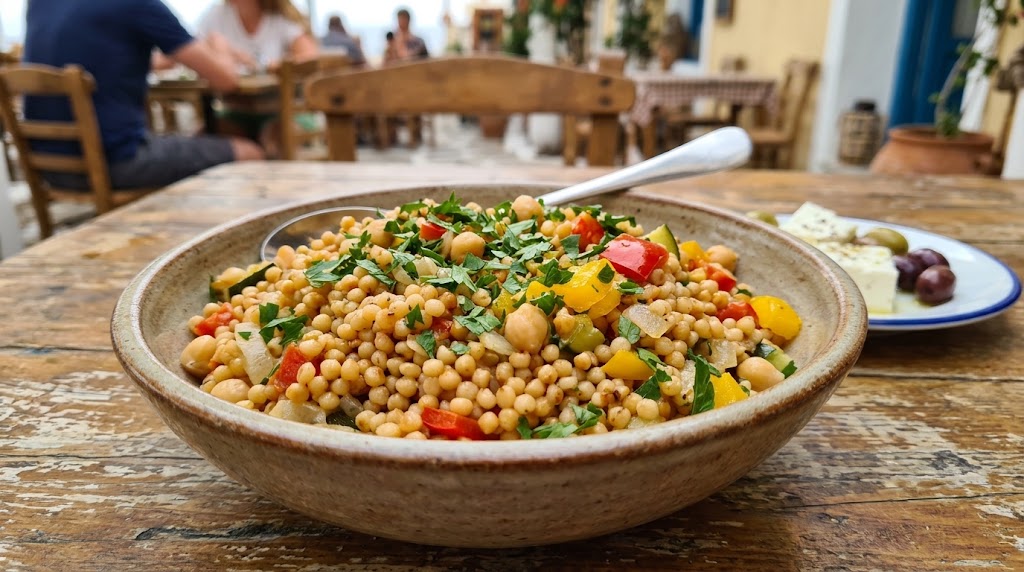
Kouskousi is a traditional Greek pasta made in tiny, rounded pieces, especially associated with the cooking of Thrace and Eastern Macedonia. It resembles couscous, but the resemblance can be misleading. Greek versions are commonly cooked in boiling water or broth like pasta, while traditional North African couscous is prepared by rolling semolina into grains and steaming them.
That difference is more than a technical detail. It affects what goes into the food, how long it cooks, and the texture you get on the plate. If you have found kouskousi on a menu, in a Greek recipe, or in a food shop, understanding the label will help you prepare it properly.
What Exactly Is Kouskousi?
In Greek, the name appears as κουσκούσι. Kouskousi describes very small pieces of pasta, often shaped as irregular little beads rather than long strands or tubes. You may also encounter κουσκουσάκι, transliterated as kouskousaki, on commercially packaged Greek pasta.
The name invites confusion because some English-language articles use Kouskousi as another spelling of North African couscous. Both foods can contain wheat semolina and both absorb flavors beautifully. But in Greek culinary descriptions, the term refers to a regional pasta tradition in its own right.
One useful clue is the recipe. If it calls for simmering the ingredient with chicken, adding it directly to soup, or boiling and draining it, the writer probably means the Greek pasta. If it calls for steaming semolina granules or rehydrating precooked couscous, it describes a different preparation.
Where Does It Come From?
Kouskousi has a documented place in the food traditions of Eastern Macedonia and Thrace, in northern Greece. Greek culinary writing describes it as a specialty made from wheat flour, sometimes combined with semolina or cracked wheat, plus ingredients such as eggs, milk, and salt.
This is not a recently invented internet food name. The Greek newspaper Ta Nea described κουσκούσι among regional homemade pastas in an article published on October 8, 1999. The account discusses tiny pasta beads prepared alongside other distinctive Greek shapes.
The deeper history of individual family recipes is harder to pin down. There is no reliable basis for naming a single inventor or an exact year of origin. What is well documented is the tradition of making, drying, storing, and serving small pastas in Greek households.
How the Traditional Pasta Is Formed
Instead of cutting dough into ribbons, cooks work it into numerous tiny pieces. Regional descriptions refer to rubbing or breaking up the dough by hand or through a sieve, then spreading the pieces to dry. The small size makes the finished pasta especially suited to brothy dishes.
Greek food traditions are not completely uniform: one family’s recipe may contain sheep’s milk, while a commercial pasta might contain only durum wheat semolina and water. It is better to think of the name as identifying a style of pasta than one universally fixed ingredient formula.
Kouskousi vs. Couscous: The Practical Difference
Traditional North African couscous has its own extensive heritage. UNESCO recognized the knowledge and practices associated with its production and consumption in 2020, following a joint nomination by Algeria, Mauritania, Morocco, and Tunisia. That recognition concerns couscous traditions, not the Greek pasta as a separate heritage listing.
| Feature | Greek kouskousi | Traditional North African couscous |
|---|---|---|
| Form | Tiny rounded pasta pieces | Small granules formed from semolina |
| Typical ingredients | Wheat flour or semolina; some recipes add eggs and milk | Commonly durum wheat semolina and water |
| Traditional cooking | Boiled or simmered like pasta | Steamed, often above a stew |
| Common use | Soups, saucy dishes, lentils, meat, vegetables | Served with vegetable, legume, meat, or other accompaniments |
| Texture | Tender, sometimes slightly chewy | Light, separate granules when prepared well |
Modern instant couscous introduces another wrinkle: many supermarket products are precooked and need only hot water and a covered rest. Pouring hot liquid over uncooked Greek pasta will not reliably produce the same result.
The labels matter more than the English name. A product sold as “Greek couscous” may actually be an egg-and-milk pasta that must be boiled.
What Is Kouskousi Made From?
Traditional recipes may include wheat flour, semolina, eggs, milk, and salt. Ingredients vary by region and producer, and not every version contains dairy or eggs.
For example, Kouskousi from some Greek producers is handmade small pasta containing semolina, durum wheat flour, egg, cow’s milk, and salt. Other commercially sold kouskousaki products use simply durum wheat semolina and water. The finished color can range from pale cream to a richer yellow, depending partly on the ingredients.
If you are buying it for a recipe, look for the ingredient list rather than assuming that all small, round wheat products are equivalent. The distinction is especially important for people avoiding eggs or milk.
How to Cook Kouskousi Without Guesswork
First, Identify the Product
Check whether the package calls it pasta and gives boiling instructions. Also check whether you bought a dried handmade product or an instant couscous product. They should not be prepared with the same default method.
Boil It Like Small Pasta
For a Greek Kouskousi pasta product, bring a generous pot of water or broth to a boil. Add the pasta, stir to keep the tiny pieces from settling together, and cook according to the package instructions. Taste toward the end: the pieces should be tender, not hard in the center.
Cooking times can differ considerably. One Greek handmade producer recommends approximately 5–7 minutes, while a supermarket-listed commercial kouskousaki product specifies 12–14 minutes. This is why a single universal cooking time would be unreliable.
Drain the pasta if the dish calls for a separate sauce. For a soup, it can cook directly in the broth; just allow for the extra liquid it absorbs.
Keep the Texture Right
Use enough liquid for the pasta to move as it cooks, and stir occasionally. When making a soup, add the pasta nearer the end so it does not sit in hot broth for too long. If the soup thickens after standing, loosen it with a little extra hot stock.
If your package is actually instant North African couscous, ignore these pasta steps and follow its stated water-to-couscous ratio and resting time instead.
Three Easy Ways to Serve It
With Tomatoes, Chickpeas, and Herbs
Soften onion and garlic in olive oil, add chopped tomatoes and cooked chickpeas, and simmer until the sauce is flavorful. Fold in separately cooked Kouskousi, then finish with parsley and a squeeze of lemon. This is an adaptable home-cooking idea rather than a claim about one definitive regional recipe.
In a Chicken and Vegetable Soup
A spoonful of the tiny pasta can make a light broth more substantial. Add it after the chicken and firm vegetables are nearly cooked. Because small pasta absorbs liquid even after the heat is turned off, keep extra broth ready if you plan to serve the soup later.
With Lentils and Warm Spices
Lentils are a particularly useful pairing. Greek food writer Diane Kochilas has published a dish combining small Greek pasta with lentils, cumin, coriander, turmeric, and dried fruit. For a simpler variation, combine cooked lentils and pasta with softened onion, olive oil, and a little cumin.
Other familiar pairings include mushrooms, sautéed greens, tomato-based sauces, seafood, and grated Greek cheese. The small shape makes it easy to distribute the pasta throughout a dish without overwhelming the other ingredients.
Is It Nutritious? What About Allergens?
Kouskousi is primarily a wheat-based food, so it contributes carbohydrates and can form part of a balanced meal with beans, vegetables, and a protein source. The exact calories, fiber, and protein depend on the product and portion size. Whole-grain versions, when available, may provide more fiber than refined-wheat varieties.
It is not gluten-free when made from wheat. Traditional egg-and-milk versions also contain those allergens; simpler semolina-and-water products may not. People with allergies or specific dietary requirements should check the actual package, including any cross-contact warnings.
There is no sound reason to market the pasta itself as a special weight-loss food or medicinal ingredient. Its nutritional usefulness depends on the wider meal and individual dietary needs.
How to Shop for and Store It
Look in Greek specialty shops, Mediterranean food stores, or the pasta section of a retailer carrying Greek imports. Useful labels include κουσκούσι, κουσκουσάκι, “Greek couscous,” and “traditional Greek pasta.” If the product is only labeled “couscous,” examine the instructions carefully.
Store unopened dried pasta in a cool, dry place, following the package date and storage guidance. After opening, keep it sealed away from moisture. Refrigerate cooked leftovers promptly in a covered container, and reheat them thoroughly.
When replacing the pasta in a recipe, small orzo is often a practical substitute for a soup or saucy dish, although its shape is different. Pearl couscous may work in some applications, but it is not identical. Fine instant couscous is a less reliable one-for-one substitute when a recipe depends on pasta cooking in broth.
The Takeaway
Kouskousi is worth understanding on its own terms: a small Greek pasta with regional roots, varied recipes, and a place in comforting everyday meals. The likeness of Kouskousi to couscous explains the naming confusion but not the correct cooking method. Start with the ingredient label, follow the product’s instructions, and try it in a soup or a simple tomato-and-legume dish.
