

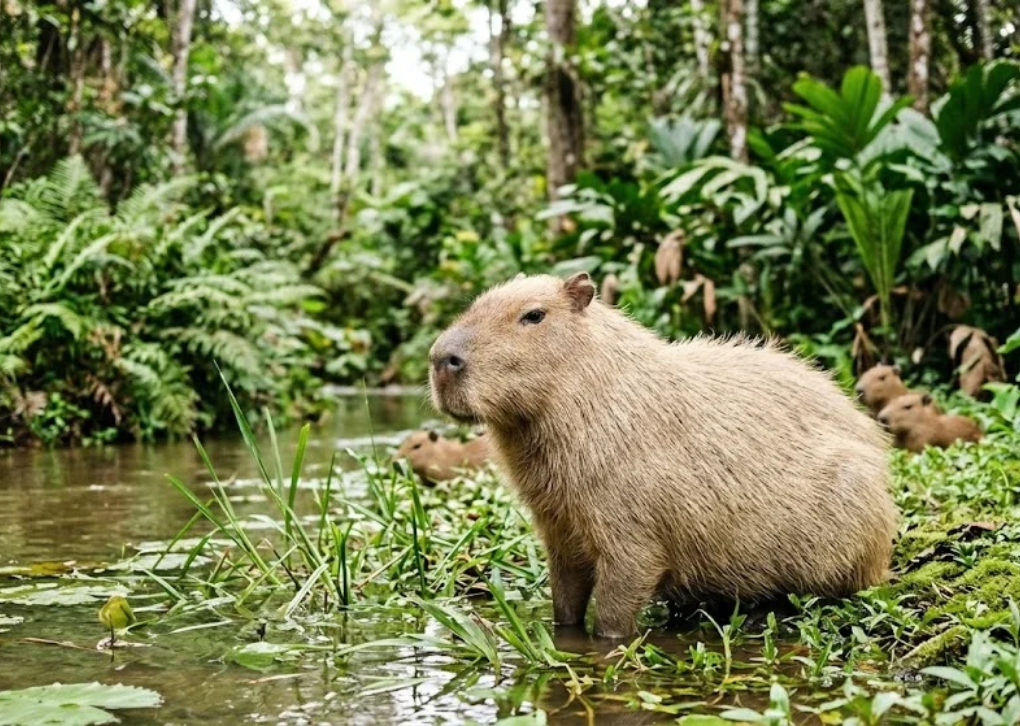
If you spotted the word Cadibara in a video caption, comment, or search result, it probably refers to a capybara. That is the standard English name for a remarkable South American mammal: the largest living rodent on Earth. Cadibara is not the recognized name of a separate animal species.
There is more to the story than a spelling correction. Capybaras have an unusual relationship with water, a highly social way of life, and adaptations that help them survive alongside powerful predators. Their seemingly unbothered expressions have also made them internet favorites. Here is what the name means, which facts are supported by zoology, and what short videos often leave out.
What Does Cadibara Mean?
Cadibara is generally used as a nonstandard spelling of capybara. Search results and informal web pages use it to refer to the same large, semiaquatic rodent, not a newly discovered species. The accepted scientific name of the familiar greater capybara is Hydrochoerus hydrochaeris.
The altered spelling might come from someone hearing the word spoken, typing it from memory, or using an informal variation online. But these are plausible explanations, not a documented history. No reliable evidence establishes the first person to write Cadibara or proves that one particular meme created the term.
For schoolwork, wildlife articles, and species identification, write capybara. In a conversation about a caption or username, Cadibara can be understood from context. If it names a particular brand or account, however, its meaning should be checked separately.
If you encountered Cadibara by hearing the name aloud, the standard English pronunciation is approximately kap-ee-BAH-ruh, with the emphasis on the third syllable.
The Animal at a Glance
| Feature | Verified information |
|---|---|
| Standard common name | Capybara, often called the greater capybara |
| Scientific name | Hydrochoerus hydrochaeris |
| Animal group | Mammal; order Rodentia; family Caviidae |
| Native range | Much of South America |
| Typical environment | Grasslands, marshes, riverbanks, and other areas with accessible water |
| Adult length | Roughly 1.1–1.3 m (3.6–4.3 ft) |
| Adult weight | Often around 35–66 kg (77–146 lb), with variation among individuals |
| Diet | Mainly grasses and aquatic vegetation |
| Social life | Usually lives in groups rather than alone |
| Conservation | Least Concern in the latest available IUCN global assessment, dated 2016 |
These facts describe the animal behind Cadibara, not a newly named species. The word Cadibara is a spelling variation, not a category in this classification. Scientists also distinguish a lesser capybara, Hydrochoerus isthmius, which is a separate taxon. That genuine biological distinction should not be confused with an internet spelling variation.
Why Capybaras Look Unlike Other Rodents
Picture a guinea pig stretched to the length of a small bench, with sturdy legs, a blunt muzzle, small rounded ears, and a barely visible tail. The resemblance is not accidental: capybaras are closely related to guinea pigs and other cavies. They are rodents, despite sometimes being mistaken for pigs or miniature hippopotamuses.
Their coarse brown coat is relatively sparse. Their bodies are heavy and barrel-shaped, and their hind legs are slightly longer than their front legs. Four toes on each front foot and three on each hind foot help support movement through wet ground; partial webbing between the toes also assists in swimming.
The most useful feature is easy to overlook. A capybara’s eyes, ears, and nostrils sit high on its head. When most of the body is underwater, these organs can remain near the surface. That arrangement helps it stay aware of its surroundings without exposing much of itself. Pictures tagged Cadibara sometimes capture exactly this posture: an animal mostly submerged, with only its upper head visible.
Like other rodents, capybaras have front incisors that continue growing. Gnawing and chewing tough plants help wear those teeth down. Size may make them unusual, but their basic biology is unmistakably rodent.
Where Capybaras Live—and Why Water Matters
Wild capybaras occur across much of South America, including parts of Brazil, Colombia, Venezuela, Uruguay, and Argentina. They favor places where grazing land meets reliable freshwater: marshes, floodplains, grassy river margins, and lake edges.
Water is not merely somewhere they take a pleasant dip. It helps them regulate body temperature, provides a route away from danger, and supports the plants they eat. They often rest in water or mud during hot periods, then graze when conditions are cooler.
Capybaras are capable swimmers and divers. Their partially webbed feet help propel them, and they can remain submerged for up to about five minutes when escaping a threat. They still need to surface to breathe; a capybara sitting underwater indefinitely in an edited video would not be showing normal mammal physiology.
The habitat connection explains why a grassy lawn alone is not an adequate substitute for their natural environment. A healthy capybara needs more than a place to wander: water access and space for normal movement are fundamental.
What Does a Capybara Eat?
Questions about the Cadibara diet have a simple biological answer. Capybaras are herbivorous grazers. They eat grasses and aquatic plants, occasionally taking other available plant material. Their diet is fibrous rather than rich in the sweet foods people sometimes offer animals for photographs.
Processing that fiber requires specialized digestion. Capybaras practice coprophagy, meaning they re-ingest certain fecal material to recover nutrients produced during digestion. It may seem strange to people, but it is a natural part of how these mammals use a plant-based diet.
Their teeth and feeding habits are connected. Continuously growing incisors help cut vegetation, while grinding teeth break down tough plant matter. Feeding a wild capybara snacks from a human hand can interfere with natural behavior and create unnecessary close contact. Watching without feeding is the better choice.
The Truth Behind Their Peaceful Reputation
An online video may show a capybara sitting still beside a bird, turtle, or another animal. That calm appearance has made Cadibara-related posts popular, but it does not mean capybaras are endlessly patient or friendly toward every species.
They are genuinely social. A typical group may contain about ten or more animals, with adults and young living together. Group members communicate through sounds, scent marking, and body language. A sharp bark can warn others of danger, prompting animals to move toward water.
There is also competition within groups. Males may establish dominance, defend space, and chase one another. A resting animal might appear relaxed because it feels secure, not because it has no instincts or cannot become frightened.
That is why a Cadibara meme cannot tell you how a particular animal will behave. This distinction matters in real life. A wild capybara that tolerates nearby animals in one photograph is not inviting people to hug it. Give wildlife room to move away, and never corner an animal for a selfie.
Babies, Predators, and Life in the Wild
Capybara mothers give birth after a pregnancy of roughly five months, often to several pups. Newborns are relatively well developed: they can stand and move soon after birth and begin sampling grass at an early age. Young animals may nurse from females other than their own mother, an example of the group care that helps them survive.
Despite their size, adult capybaras are not free from predators. Jaguars can hunt them, while caimans, anacondas, and other predators are especially dangerous to younger animals. Staying alert, calling out, gathering in groups, and retreating into water all improve their chances.
In the wild, life expectancy varies with food, disease, hunting, and predation. Zoological references describe an average of about six years in the wild, with some individuals living longer. Animals in managed care may reach around twelve years. Those figures are general observations, not promises for any particular animal.
How Cadibara Became Part of Internet Searches
Capybaras had online fans before the recent meme boom, but short-form videos gave their unhurried movements and deadpan expressions a much wider audience. During 2022 and 2023, clips set to a repetitive capybara song circulated widely, reinforcing the animal’s association with a relaxed, humorous mood.
Why does the alternative spelling appear? People may reproduce unfamiliar words as they sound, type them incorrectly, or adapt them for jokes and captions. Cadibara fits those possibilities, but the precise origin and frequency of the spelling have not been established by a reliable linguistic study. It would be misleading to assign a definite inventor or date.
One useful distinction: a viral image is evidence of a moment, not a species-wide personality trait. A capybara that looks tranquil while another animal sits nearby may still react defensively under different circumstances. Enjoy the humor without mistaking it for a wildlife-care manual.
Can You Keep a Capybara as a Pet?
The idea of a Cadibara pet may sound charming online, but a capybara is not a practical pet for an ordinary home. Even where private ownership is legal, the animal’s welfare needs are demanding: appropriate social companionship, substantial secure outdoor space, grazing opportunities, reliable swimming and soaking access, and professional veterinary support.
A solitary capybara may be deprived of the social interactions that are central to its normal behavior. Its strength, teeth, and ability to become defensive also make casual handling risky. Children should not be encouraged to approach one simply because a video shows a person petting it.
Ownership rules depend on the country, state, and local authority, so broad claims that capybaras are universally legal—or universally banned—are inaccurate. Anyone considering exotic-animal ownership should check current local law and consult an experienced exotic-animal veterinarian and a qualified animal-welfare professional before making a decision. For most admirers, visiting a reputable wildlife facility is a better option.
Are Capybaras Endangered?
The greater capybara is classified as Least Concern by the International Union for Conservation of Nature (IUCN). The latest global assessment available during this review was published in 2016 and recorded an overall stable population trend.
That status does not mean every local population is secure. Hunting, wetland damage, and conflicts with people can put pressure on particular areas. These animals also play a role in their ecosystems by grazing vegetation and providing prey for other wildlife.
Preserving wetlands protects far more than one photogenic mammal. It maintains habitat for aquatic plants, birds, fish, and predators that depend on the same connected landscape.
Which Name Should You Use?
If you are writing a school report, searching scientific databases, or labeling an animal photograph, use capybara. That spelling leads to reliable identification and established zoological references. Use Hydrochoerus hydrochaeris when you need the scientific species name.
Cadibara is useful mainly when explaining a search term or quoting how someone wrote it online. It should not be presented as a different animal, an official subspecies, or a proven new zoological discovery.
Final Thoughts
The mystery behind Cadibara has a straightforward answer: in animal-related contexts, it normally points to the capybara. The real creature is more interesting than the spelling confusion. It is a powerful swimmer, a selective plant eater, an alert group-living mammal, and an important part of South American wetland life. If a cheerful video sparked your interest, take the next step by learning about the animal’s actual behavior and supporting responsible wildlife observation.
5. Frequently Asked Questions
Is Cadibara a real animal?
The animal people usually mean is real, but Cadibara is not an accepted zoological species name. The standard English name is capybara, typically referring to Hydrochoerus hydrochaeris.
How do you pronounce capybara correctly?
Say kap-ee-BAH-ruh, emphasizing “BAH.” English dictionaries record small differences between British and American pronunciation, but both use the standard spelling capybara.
Can capybaras breathe underwater?
No. They are air-breathing mammals. They can remain submerged for several minutes—up to about five minutes in documented descriptions—but must eventually come up for air.
Are capybaras dangerous to humans?
They are often calm when undisturbed, but they are still large wild rodents with strong teeth. A frightened, cornered, or stressed capybara may bite. Observe from a respectful distance rather than trying to handle it.
Do capybaras get along with other animals?
They sometimes tolerate other species nearby, and birds may feed on insects stirred up by their movement. That does not guarantee safe interactions with every animal. Individual behavior and circumstances matter.
How long do capybaras live?
Published zoological summaries describe about six years on average in the wild, with some reaching around ten years. In professional care, individuals may live for approximately twelve years.
Is the Cadibara animal endangered?
The greater capybara is currently listed as Least Concern in the IUCN assessment available for this review. The assessment dates to 2016, and local threats such as hunting and habitat damage can still affect populations.

5 Comments
Pingback: Lalania Hudson: Age, Parents, Siblings & Biography Copy
Pingback: Dede Moseley: What We Know About Eric Thomas's Wife
Pingback: Juanita Katt: Barbara Hale's Daughter and Family Story
Pingback: Verna Aho: Lauri Markkanen’s Wife, Family & Life
Pingback: Leslie Knipfing: Kevin James's Sister and Her Life