

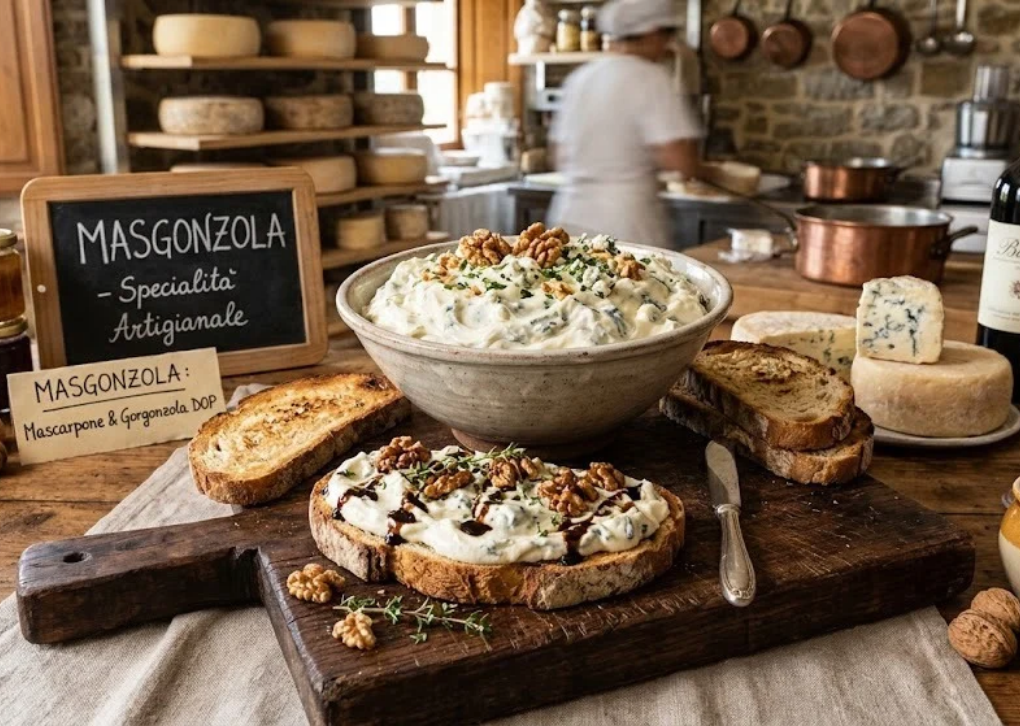
Masgonzola is a creamy combination of two Italian dairy specialties: blue-veined Gorgonzola and mild mascarpone. It may come as a layered cheese with contrasting white and blue-streaked bands, or as a softer, mixed spread. The mascarpone rounds out Gorgonzola’s salty tang without completely hiding it.
The name is useful, but it can be confusing. It does not identify a separate cheese with its own protected Italian production rules. Understanding the ingredients, rather than relying on the name alone, makes it easier to choose a product, estimate its nutritional content, or prepare a similar version at home.
What exactly is Masgonzola?
The word joins part of mascarpone with part of Gorgonzola. It describes a pairing rather than a new variety produced through a separate cheese-aging process. Swiss culinary publisher Betty Bossi uses the name explicitly in recipes and identifies the ingredient as Gorgonzola with mascarpone. Italian dairies manufacture the same pairing under descriptive labels such as Gorgonzola e mascarpone.
These products are real, even when the particular name is absent from the packaging. Some cheese counters sell neatly layered blocks; others offer tubs or portions suitable for spreading. Ingredient proportions can differ between makers, so two products may have noticeably different textures and flavors.
The two cheeses behind the blend
Gorgonzola brings the blue-cheese character
Gorgonzola is made from cow’s milk and develops blue-green veins through selected mold cultures during maturation. The milder dolce style is usually soft and creamy, while piccante is firmer and has a more pronounced bite. A combination made with dolce tends to be gentle; one made with piccante will usually be more assertive.
Its salt, savory aroma and lingering tang are what prevent the finished blend from tasting like plain cream cheese.
Mascarpone supplies richness and balance
Mascarpone is a soft, high-fat dairy product made from cream. Its delicate flavor and smooth body make the blue-cheese notes feel less forceful. In a layered version, it also forms the pale bands between streaks of Gorgonzola; in a mixed version, it creates a more uniform spread.
Adding mascarpone changes the balance of the food, but it does not automatically make it lower in calories or suitable for people avoiding lactose.
Is Masgonzola an officially protected Italian cheese?
No separate protected designation for the combined name was established by the official Gorgonzola specifications reviewed. Gorgonzola itself is a Protected Designation of Origin (PDO) product, with defined geographic and manufacturing requirements. That protection belongs to the original cheese, not automatically to a prepared mixture containing it.
This matters when shopping for Masgonzola. A package saying Gorgonzola DOP refers to the protected cheese; a package saying Gorgonzola with mascarpone describes a combined food. Check whether the producer identifies the Gorgonzola component as PDO if that authenticity matters to you.
Some online descriptions assign Masgonzola its own centuries-old origin story, fixed maturation schedule or official cheese categories. Those claims are not established by the manufacturer and regulatory evidence reviewed. The blue cheese develops its characteristic veins before the two dairy components are combined.
How is Masgonzola made, and what does it look like?
Commercial producers typically prepare or obtain the two cheeses and combine them as a finished dairy specialty. One Italian cheesemaker, casArrigoni, describes arranging alternating layers of mild Gorgonzola and mascarpone. The cut surface shows smooth white or cream-colored bands interspersed with blue-veined portions.
A mixed style looks different: the ingredients are folded or stirred together, creating a relatively even spread with small blue-cheese streaks. The mixing changes how the flavors arrive on the palate but is not a new fermentation method. There is no universal percentage of each ingredient that defines Masgonzola.
Taste and texture: what should you expect?
A typical bite of Masgonzola begins with a buttery, milky sensation, followed by a salty, lightly earthy finish. The stronger the blue-cheese proportion, the more noticeable that finish becomes. Texture may range from scoopable to sliceable, depending on the product and serving temperature.
| Feature | Mascarpone | Gorgonzola | The combined specialty |
|---|---|---|---|
| Dominant taste | Mild, creamy | Salty, tangy, blue-cheese flavor | Creamy with a blue-cheese finish |
| Texture | Thick and smooth | Soft (dolce) to firmer (piccante) | Spreadable or visibly layered |
| Best role | Richness and body | Stronger savory flavor | Balanced spreads, sauces and toppings |
Masgonzola can appeal to someone who finds straight Gorgonzola overpowering, although a high-blue-cheese version may still taste quite strong. If you are buying for guests, the specific ingredient ratio is a better guide than the product name.
Masgonzola nutrition: what real labels show
There is no single reliable nutritional profile for every product sold under this name. Fat, protein, salt and calories depend on the two cheeses and their relative amounts. That is why manufacturer labels are more useful than a generic online nutrition table.
For example, casArrigoni publishes these figures for one of its Gorgonzola-and-mascarpone products:
| Nutrient | Per 100 g | Approximate 30 g serving* |
|---|---|---|
| Energy | 394 kcal | 118 kcal |
| Total fat | 38 g | 11.4 g |
| Saturated fat | 26 g | 7.8 g |
| Carbohydrates | 1.2 g | 0.36 g |
| Protein | 12 g | 3.6 g |
| Salt | 0.6 g | 0.18 g |
The serving column is calculated directly from that manufacturer’s per-100-g figures and rounded where appropriate. It is not a separate laboratory measurement.
The same producer lists different values for an organic version, including 342 kcal and 32 g fat per 100 g. That difference shows why it would be misleading to promise a universal calorie count. Masgonzola can contribute protein, but the blend is also rich in fat, including saturated fat. Portion size matters, and anyone monitoring salt intake should use the label of the particular product they buy.
How to buy Masgonzola that suits your tastes
Look beyond the word on the front of the package. Labels may say Gorgonzola and mascarpone, Gorgonzola e mascarpone or Gorgonzola with mascarpone without using Masgonzola at all.
For a cheese board, a firm-enough layered block makes attractive slices and shows off the contrast between the components. For a dip or quick sauce, a tub-style mixture can be more convenient. Check the ingredient percentages: a higher mascarpone share generally means a gentler blue-cheese taste, whereas more Gorgonzola makes it bolder.
Read the milk allergen statement, refrigeration directions, use-by date and ingredient list. Some cheese varieties use animal-derived rennet; do not assume a Gorgonzola-containing product is vegetarian without confirming its ingredients or certification.
How to make a simple version at home
A homemade Masgonzola-style spread needs just two ingredients. This adaptable starting ratio makes a mildly tangy accompaniment to bread, vegetables or warm potatoes:
Ingredients for approximately 120 g
-
80 g plain mascarpone
-
40 g Gorgonzola Dolce, with any packaging removed
-
Place the cheeses in a clean bowl. Break the Gorgonzola into small pieces with a fork.
-
Fold in the mascarpone until the mixture is as smooth or marbled as you prefer. Taste it before adding any seasoning; the blue cheese already brings salt.
-
Serve promptly with crackers or sliced pears, or cover and refrigerate. If you want a stronger result next time, try an equal-weight mixture instead.
For visible layers rather than a dip, spread thin alternating portions of each cheese into a small lined container and chill until firm enough to slice. Home layering will not necessarily replicate the texture of a manufactured block. Keep utensils clean and the ingredients refrigerated except during brief preparation.
Five ways to serve it without overwhelming the dish
On toasted bread: Add a small spoonful to crostini and finish with sliced pear or a little fig preserve. Fruit sweetness provides contrast without masking the tang.
With pasta or gnocchi: Loosen a modest amount in a warm pan with a splash of pasta-cooking water, then toss with the pasta. Avoid prolonged hard boiling, which can make a rich dairy sauce separate.
On pizza: Use small dollops as an accent alongside milder cheeses and vegetables. It is not a direct substitute for mozzarella, because it brings a richer, saltier flavor and behaves differently when heated.
In a salad: Pair small pieces with bitter greens, apple and toasted walnuts. An acidic dressing helps balance the creamy richness.
On a cheese board: Offer fresh figs, crusty bread and unsalted nuts. Keep accompaniments simple so guests can distinguish the sweet mascarpone from the stronger Gorgonzola notes.
These ideas work best when Masgonzola is treated as a flavorful ingredient rather than used in the same quantity as a mild everyday cheese.
Storage, allergies and food safety
Keep purchased cheese refrigerated according to its packaging. For homemade mixtures, use a clean, covered container, refrigerate promptly and consume within the shortest applicable date indicated for the ingredients; do not assume a homemade blend inherits an unopened commercial product’s shelf life.
Food-safety guidance recommends keeping refrigerators at 4°C (40°F) or colder and returning perishable foods to refrigeration within two hours, or within one hour when the temperature exceeds 32°C (90°F). If soft cheese has been held too warm for too long, discard it rather than judging safety by taste or smell.
Masgonzola contains milk. It is not automatically lactose-free, and formulas can vary. During pregnancy, and for people at elevated risk from foodborne infections, extra care is warranted: follow applicable health guidance, check that soft and blue-veined cheeses are made from pasteurized milk, and consult a healthcare professional if uncertain about dietary safety.
The takeaway
Masgonzola is best understood as a convenient meeting of two established Italian dairy products, not as a separate PDO cheese with a fixed recipe. Its appeal is the contrast between mild creaminess and tangy blue-cheese flavor. Choose by the ingredient ratio and nutrition label—or make a small batch at home to find the balance you enjoy.
5. Frequently Asked Questions
1. Is Masgonzola the same as Gorgonzola?
No. Gorgonzola is a protected Italian blue cheese, while Masgonzola describes a combination of Gorgonzola and mascarpone. The addition of mascarpone usually creates a softer texture and milder blue-cheese flavor.
2. Does Masgonzola contain blue mold?
Yes, because one of its ingredients is Gorgonzola, whose characteristic blue-green veins come from selected edible cheese cultures. These cultures are part of the intended cheese production process and are different from unexpected spoilage mold.
3. Can cream cheese replace mascarpone?
Yes, plain cream cheese can provide a spreadable base, although it usually tastes tangier than mascarpone. The finished product will have a different flavor and texture, so begin with a small quantity of Gorgonzola and adjust gradually.
4. Is Masgonzola lactose-free?
Not necessarily. Both the specific Gorgonzola and mascarpone ingredients matter, and lactose levels may vary between products. People who need to avoid lactose should rely on verified labeling rather than assuming that all cheese mixtures are lactose-free.
5. Is Masgonzola safe to eat during pregnancy?
Safety depends on the ingredients, milk pasteurization and handling. FDA guidance advises pregnant people to avoid soft or blue-veined cheeses made from unpasteurized milk. Check product labeling and follow local medical guidance, particularly for ready-to-eat soft cheeses.
6. Can Masgonzola be frozen?
It can be frozen, but freezing may damage its smooth texture and cause separation after thawing. For the best eating quality, use it fresh. If frozen safely, thaw it in the refrigerator and consider using it in cooked dishes rather than serving it as a cold spread.
